




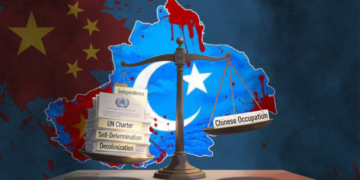



Summary: Exile government says the term ‘Xinjiang’ reflects historical colonial naming and territorial control narratives.
By The East Turkistan Post Staff | April 8, 2026
WASHINGTON — East Turkistan, what Beijing calls ‘Xinjiang (New Territory),’ is at the centre of a naming dispute. The East Turkistan Government in Exile (ETGE) has formally rejected the term ‘Xinjiang’ as a territorial designation. The group says the name reflects historical policies imposed after Qing-era expansion into the territory.
The ETGE issued its statement on April 8. It said the term ‘Xinjiang,’ which translates as ‘New Territory’ in Chinese, must be understood in its historical context. Moreover, the group argued that the name relates directly to administrative naming practices introduced after the Qing dynasty incorporated the territory in 1884.
ETGE links terminology to historical governance and control
The ETGE said the name ‘Xinjiang’ carries political and historical implications tied to governance and territorial control. Furthermore, the statement noted that native communities — including Uyghur, Kazakh, Kyrgyz, Uzbek, and Tatar populations — use the term East Turkistan in cultural and historical contexts.
‘We reject the use of the term Xinjiang, which translates to New Territory,’ the organisation said in its April 8 statement.
The group also referenced historical boundaries as part of its argument regarding territorial distinctions. These include interpretations involving the Great Wall of China as a historical administrative limit. However, these interpretations are subject to differing academic and political perspectives.
Statement references 1949 political transition and subsequent policies
The ETGE linked its position to events surrounding 1949. In that year, political control of East Turkistan shifted following the establishment of the People’s Republic of China. The group referenced historical accounts of leadership changes within the former East Turkistan Republic. These include a reported aircraft crash involving senior officials travelling to the Soviet Union. Soviet archival records document the crash near Irkutsk, though independent verification of specific related claims varies across historical sources.
The ETGE also cited declassified materials referring to interactions between Joseph Stalin and Mao Zedong during that period. Additionally, the statement referenced policies related to population management, cultural heritage sites, and economic administration in East Turkistan. These include claims regarding birth control measures, destruction of cultural sites, and resource management structures such as the Xinjiang Production and Construction Corps.
China’s position and verification constraints
Chinese authorities consistently state that policies in East Turkistan promote economic development, social stability, and legal governance. Officials reject allegations that administrative terminology or governance practices reflect coercive intent. Beijing has not issued a specific response to the ETGE’s April 8 statement on territorial naming.
Independent verification of historical and contemporary claims in the statement remains limited. Restricted access to archival materials and on-the-ground research inside East Turkistan constrains outside assessment of specific claims.
The East Turkistan Post is an independent news publication. All claims are attributed to their respective sources. Access restrictions inside East Turkistan limit independent on-the-ground verification.
