

Saturday, April 18, 2026
No Result
View All Result
The East Turkistan Post
  • Home
  • News
    • All
    • East Turkistan
    • Exile
    • International

    Evidence mounts of systematic forced labour in East Turkistan

    Beijing and exile groups clash over East Turkistan narrative

    China’s power grid relies on East Turkistan resources

    East Turkistan briefing challenges China’s soft power claims

    China creates new divisions in East Turkistan, ETGE objects

    ETGE criticises China’s role in UN Islamophobia observance

    ETGE marks 81st anniversary of East Turkistan National Army Memorial Day

    ETGE marks 36th anniversary of Baren uprising with calls for international action

    ETGE rejects ‘Xinjiang’ as name for East Turkistan

  • Explainer
    • All
    • In-Depth
    Five years after genocide recognition, China’s campaign against Uyghurs and other Turkic peoples continues

    Five years after genocide recognition, China’s campaign against Uyghurs and other Turkic peoples continues

    How labeling Uyghurs a “minority” enables China’s denial of East Turkistani self-determination

    How labeling Uyghurs a “minority” enables China’s denial of East Turkistani self-determination

    Why Isa Yusuf Alptekin’s legacy has reignited divisions among East Turkistanis in exile

    CECC Report: China’s Genocide in East Turkistan Is Being Reorganized, Not Ended

    CECC Report: China’s Genocide in East Turkistan Is Being Reorganized, Not Ended

    How China Reframed East Turkistan’s Independence Struggle to Deny the Right to Self-determination

    How China Reframed East Turkistan’s Independence Struggle to Deny the Right to Self-determination

  • Politics
  • Business & Economy
  • Science & Tech
  • Life
    • All
    • Community
    • Culture & Arts
    • Health
    • History
    • Religion

    Beijing and exile groups clash over East Turkistan narrative

    East Turkistan briefing challenges China’s soft power claims

    ETGE criticises China’s role in UN Islamophobia observance

    ETGE marks 81st anniversary of East Turkistan National Army Memorial Day

    ETGE marks 36th anniversary of Baren uprising with calls for international action

    ETGE rejects ‘Xinjiang’ as name for East Turkistan

    Archives detail East Turkistan statehood and two 20th-century republics

    China releases Blue Book on human rights in East Turkistan

    Archaeological record supports East Turkistan’s historical borders, archives say

    ETGE publication tracks abuses and international responses in East Turkistan

  • Opinion
    • All
    • Guest Essays
    International Law Affirms East Turkistan’s Right to Independence

    International Law Affirms East Turkistan’s Right to Independence

  • English
    • Türkçe
    • Русский
    • 简体中文
    • ئۇيغۇرچە
    • Уйғурчә
    • Uyghurche
The East Turkistan Post
No Result
View All Result
Home Business & Economy

Evidence mounts of systematic forced labour in East Turkistan

by ETPostEditor
April 16, 2026
in Business & Economy, East Turkistan, Politics
Reading Time: 3 mins read

New investigations describe detention-linked labour and rural transfers across East Turkistan.
By The East Turkistan Post Staff | April 15, 2026

The Infrastructure of Coercion

Investigative findings have confirmed that East Turkistan, which Beijing calls ‘Xinjiang (New Territory),’ is the site of a sophisticated and systematic forced labour regime. This state-imposed system operates through a network of industrial parks, camp-integrated factories, and involuntary rural transfers, forming a core pillar of the ongoing genocide and colonial project.

Testimony from survivors and whistleblowers, corroborated by satellite imagery and leaked state documents, indicates that the native population of East Turkistan is being forcibly integrated into a workforce designed for socio-economic and ideological transformation. This institutionalized social engineering seeks to dismantle traditional livelihoods and replace them with state-monitored industrial servitude.

Dual Mechanisms of Labour Exploitation

The forced labour apparatus in East Turkistan functions through two primary tracks, according to independent researchers.

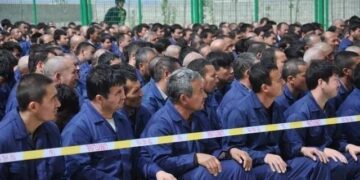
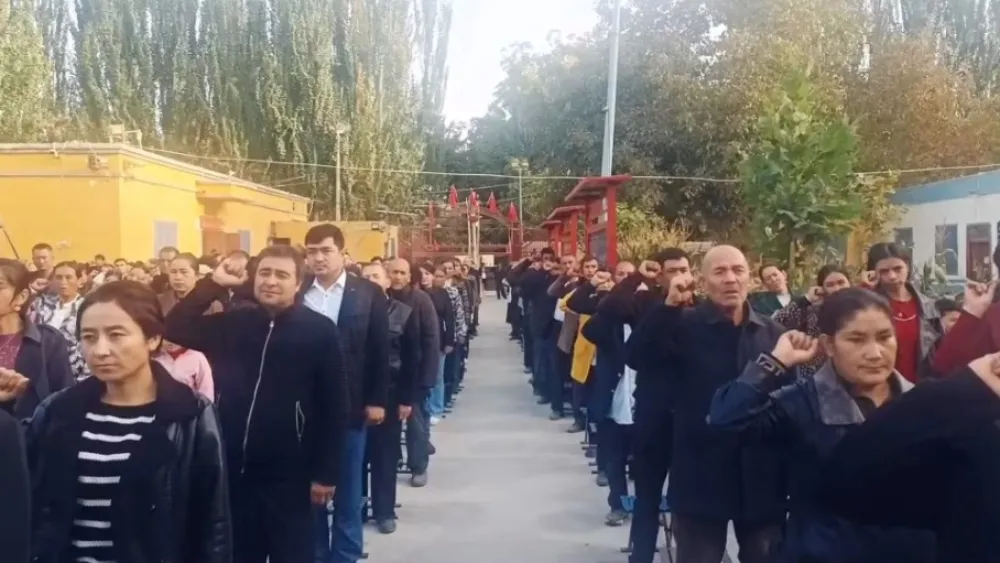
The first track is directly linked to the mass internment system. Detainees are often forced to “graduate” from concentration camps only to be funneled into high-security industrial parks. This “seamless connection” ensures that those released from physical cells remain under the absolute control of the occupation authorities within factory walls. Refusal to participate in these programs is categorized as political defiance, carrying the immediate threat of re-internment.

The second track targets the broader rural population under the guise of “poverty alleviation” and “Xinjiang Aid” programs. While Chinese authorities portray these transfers as voluntary, evidence shows that government work teams in East Turkistan use door-to-door mobilization and coercive “thought work” to compel compliance.

Whistleblower Accounts of Daily Operations

A former Han Chinese police officer, referred to as Mr. Zhang, provided rare firsthand testimony regarding the logistics of these transfers. According to Zhang, laborers in East Turkistan are transported in government-controlled convoys to industrial sites, often escorted by armed security personnel.

Upon arrival, officials routinely confiscate identity cards to restrict movement. Workers are reportedly housed in unheated communal dormitories and subjected to ten-hour workdays. Those who show resistance or fail to meet quotas are subjected to intensive interrogation and “thought work” sessions that frequently last until the early hours of the morning.

“When individuals resist assignments, officials deploy ‘thought work’ sessions that can last until 3 a.m. The goal is total psychological and physical submission to the state’s economic directives.” — Mr. Zhang, Former Police Officer.

Surveillance and Compliance

The Chinese occupation forces utilize a multi-layered surveillance apparatus to ensure total participation in the labour programs across East Turkistan. The “Unemployment Monitoring and Early Warning System” uses big data to track the employment status of every native inhabitant in real-time.

Failure to accept a state-assigned job is flagged by surveillance algorithms as a sign of “religious extremism” or “untrustworthiness.” Furthermore, the state has moved to seize traditional agricultural lands in East Turkistan, placing them under government trusteeships. This effectively ends independent farming, leaving the native population with no choice but to enter the colonial industrial complex to survive.

Global Supply Chain Contamination

The scale of forced labour in East Turkistan has profound implications for global trade. East Turkistan accounts for over 85% of China’s cotton production—representing roughly 20% of the world’s supply. Additionally, East Turkistan produces approximately 45% of the global supply of polysilicon, a critical component for solar panels.

The Xinjiang Production and Construction Corps (XPCC), a paramilitary organization central to the colonization of East Turkistan, plays a lead role in managing these industries. Dozens of international brands in the apparel, automotive, and electronics sectors remain at high risk of utilizing materials tainted by forced labour, effectively subsidizing the colonial administration’s operations.

International Legal Reckoning

Global bodies have increasingly recognized these practices as grave violations of international law. The UN Office of the High Commissioner for Human Rights (OHCHR) has stated that the patterns of arbitrary detention and coercive labour in East Turkistan “may constitute international crimes, in particular crimes against humanity.”

In response, the U.S. has enforced the Uyghur Forced Labor Prevention Act (UFLPA), which operates on a “rebuttable presumption” that all goods produced in East Turkistan are the product of forced labour. As more nations move toward similar legislative frameworks, the economic cost of Beijing’s colonial policies in East Turkistan continues to rise on the international stage.

The East Turkistan Post is an independent news publication. All claims are attributed to their respective sources. Access restrictions inside East Turkistan limit independent on-the-ground verification.

Tags: ForcedLabour؛ Colonization؛ GlobalSupplyChains
Previous Post

Beijing and exile groups clash over East Turkistan narrative

The East Turkistan Post

© 2026 East Turkistan Post

  • About Us
  • Editorial Policy
  • Editorial Position & Principles
  • Contact

Powered by
►
Necessary cookies enable essential site features like secure log-ins and consent preference adjustments. They do not store personal data.
None
►
Functional cookies support features like content sharing on social media, collecting feedback, and enabling third-party tools.
None
►
Analytical cookies track visitor interactions, providing insights on metrics like visitor count, bounce rate, and traffic sources.
None
►
Advertisement cookies deliver personalized ads based on your previous visits and analyze the effectiveness of ad campaigns.
None
►
Unclassified cookies are cookies that we are in the process of classifying, together with the providers of individual cookies.
None
Powered by
No Result
View All Result
  • English
    • Türkçe
    • Русский
    • 简体中文
    • ئۇيغۇرچە
    • Уйғурчә
    • Uyghurche
  • Home
  • News
    • East Turkistan
    • Exile
    • International
  • Explainer
    • In-Depth
    • Infographics
    • Profiles
  • Politics
  • Business & Economy
  • Science & Tech
  • Life
    • Community
    • Culture & Arts
    • Health
    • History
    • Religion
  • Opinion
    • Editorials
    • Guest Essays
    • Letters to the Editor

© 2026 East Turkistan Post