

Thursday, April 16, 2026
No Result
View All Result
The East Turkistan Post
  • Home
  • News
    • All
    • East Turkistan
    • Exile
    • International

    Evidence mounts of systematic forced labour in East Turkistan

    Beijing and exile groups clash over East Turkistan narrative

    China’s power grid relies on East Turkistan resources

    East Turkistan briefing challenges China’s soft power claims

    China creates new divisions in East Turkistan, ETGE objects

    ETGE criticises China’s role in UN Islamophobia observance

    ETGE marks 81st anniversary of East Turkistan National Army Memorial Day

    ETGE marks 36th anniversary of Baren uprising with calls for international action

    ETGE rejects ‘Xinjiang’ as name for East Turkistan

  • Explainer
    • All
    • In-Depth
    Five years after genocide recognition, China’s campaign against Uyghurs and other Turkic peoples continues

    Five years after genocide recognition, China’s campaign against Uyghurs and other Turkic peoples continues

    How labeling Uyghurs a “minority” enables China’s denial of East Turkistani self-determination

    How labeling Uyghurs a “minority” enables China’s denial of East Turkistani self-determination

    Why Isa Yusuf Alptekin’s legacy has reignited divisions among East Turkistanis in exile

    CECC Report: China’s Genocide in East Turkistan Is Being Reorganized, Not Ended

    CECC Report: China’s Genocide in East Turkistan Is Being Reorganized, Not Ended

    How China Reframed East Turkistan’s Independence Struggle to Deny the Right to Self-determination

    How China Reframed East Turkistan’s Independence Struggle to Deny the Right to Self-determination

  • Politics
  • Business & Economy
  • Science & Tech
  • Life
    • All
    • Community
    • Culture & Arts
    • Health
    • History
    • Religion

    Beijing and exile groups clash over East Turkistan narrative

    East Turkistan briefing challenges China’s soft power claims

    ETGE criticises China’s role in UN Islamophobia observance

    ETGE marks 81st anniversary of East Turkistan National Army Memorial Day

    ETGE marks 36th anniversary of Baren uprising with calls for international action

    ETGE rejects ‘Xinjiang’ as name for East Turkistan

    Archives detail East Turkistan statehood and two 20th-century republics

    China releases Blue Book on human rights in East Turkistan

    Archaeological record supports East Turkistan’s historical borders, archives say

    ETGE publication tracks abuses and international responses in East Turkistan

  • Opinion
    • All
    • Guest Essays
    International Law Affirms East Turkistan’s Right to Independence

    International Law Affirms East Turkistan’s Right to Independence

  • English
    • Türkçe
    • Русский
    • 简体中文
    • ئۇيغۇرچە
    • Уйғурчә
    • Uyghurche
The East Turkistan Post
No Result
View All Result
Home Life Culture & Arts

East Turkistan briefing challenges China’s soft power claims

by ETPostEditor
April 12, 2026
in Culture & Arts, East Turkistan, Politics, Religion
Reading Time: 3 mins read

A strategic briefing questions Beijing’s narrative, demographics, and legal claims.

By The East Turkistan Post Staff | April 12, 2026

East Turkistan, what Beijing calls ‘Xinjiang (New Territory),’ is the focus of a new strategic briefing that examines China’s soft power efforts, sovereignty claims, and demographic policy. The analysis matters because it ties political control, human rights narratives, and economic strategy to the dispute over East Turkistan’s legal status.

The briefing, attributed to an anonymous senior academic and political strategist, argues that Chinese governance should be viewed through the lens of annexation and occupation rather than domestic administration. It also cites the 2022 UN human rights assessment and Chinese state materials, including the “Human Rights Blue Book on Xinjiang,” as evidence of competing narratives.

Sovereignty and legal claims
The briefing says East Turkistan was annexed by the Qing Empire in 1884 and argues that the term “Xinjiang” reflects colonial intent. It also invokes the 1907 Hague Regulations to claim that the 1949 takeover amounted to continuing military occupation rather than a lawful transfer of sovereignty.

Chinese state narratives describe the 1949 events as a “peaceful liberation.” The briefing rejects that description and says there was no popular consent for a transfer of authority. The document presents self-determination as a continuing legal right of the indigenous population.

Human rights and narrative management
A major part of the analysis focuses on the “Human Rights Blue Book on Xinjiang.” The briefing says Beijing uses the report as a perception-management tool to link “stability” with “legal protection.” It quotes the Blue Book as saying that current measures are “guarantors of social harmony.”

The same briefing counters that these policies are associated with the removal of digital records and the suppression of religious life. Those claims are presented in the document as part of a broader system of control over an occupied population. Chinese authorities, however, maintain that such policies are lawful and intended to promote stability and development.

Demographic and cultural policy
The briefing says more than 880,500 children have been placed in state-run boarding schools, where the transmission of mother-tongue and religious education is reduced. It also says that declining birth rates among Turkic groups are linked to Chinese policies described in internal documents as “training” (培训) and “transformation” (转化).

The document connects these claims to the 2022 UN Office of the High Commissioner for Human Rights assessment, which said the abuses in Xinjiang may amount to crimes against humanity. Chinese officials have rejected that assessment and denied that their policies are coercive.

Economic significance
The briefing argues that East Turkistan is central to China’s economy and global supply chains. It says the territory accounts for more than 30 percent of China’s onshore oil reserves and 34 percent of its natural gas reserves, and that it plays a major role in cotton and polysilicon supply chains.

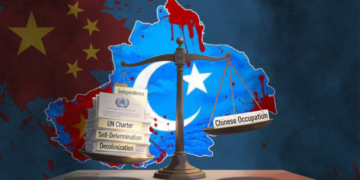
The analysis says Beijing’s soft power strategy is designed to protect those economic interests. It argues that international reliance on those supply chains creates a broader ethical and political problem. Chinese authorities have not accepted that characterisation and continue to describe East Turkistan as an integral part of China.

Political memory and resistance
The document ends by presenting independence as the only path to preserve Turkic-Islamic identity. It cites a 1938 statement attributed to General Mehmut Muhiti: “Dying is acceptable, but turning back is not an option.”

The briefing says that line remains central to political memory among East Turkistan advocates. It also calls on the international community to recognise East Turkistan as an occupied territory, a position Beijing firmly rejects.

The East Turkistan Post is an independent news publication. All claims are attributed to their respective sources. Access restrictions inside East Turkistan limit independent on-the-ground verification.

Previous Post

China creates new divisions in East Turkistan, ETGE objects

Next Post

China’s power grid relies on East Turkistan resources

Next Post

China’s power grid relies on East Turkistan resources

The East Turkistan Post

© 2026 East Turkistan Post

  • About Us
  • Editorial Policy
  • Editorial Position & Principles
  • Contact

Powered by
►
Necessary cookies enable essential site features like secure log-ins and consent preference adjustments. They do not store personal data.
None
►
Functional cookies support features like content sharing on social media, collecting feedback, and enabling third-party tools.
None
►
Analytical cookies track visitor interactions, providing insights on metrics like visitor count, bounce rate, and traffic sources.
None
►
Advertisement cookies deliver personalized ads based on your previous visits and analyze the effectiveness of ad campaigns.
None
►
Unclassified cookies are cookies that we are in the process of classifying, together with the providers of individual cookies.
None
Powered by
No Result
View All Result
  • English
    • Türkçe
    • Русский
    • 简体中文
    • ئۇيغۇرچە
    • Уйғурчә
    • Uyghurche
  • Home
  • News
    • East Turkistan
    • Exile
    • International
  • Explainer
    • In-Depth
    • Infographics
    • Profiles
  • Politics
  • Business & Economy
  • Science & Tech
  • Life
    • Community
    • Culture & Arts
    • Health
    • History
    • Religion
  • Opinion
    • Editorials
    • Guest Essays
    • Letters to the Editor

© 2026 East Turkistan Post