




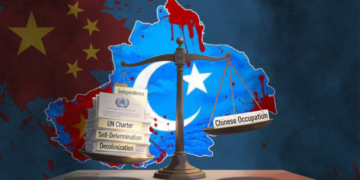


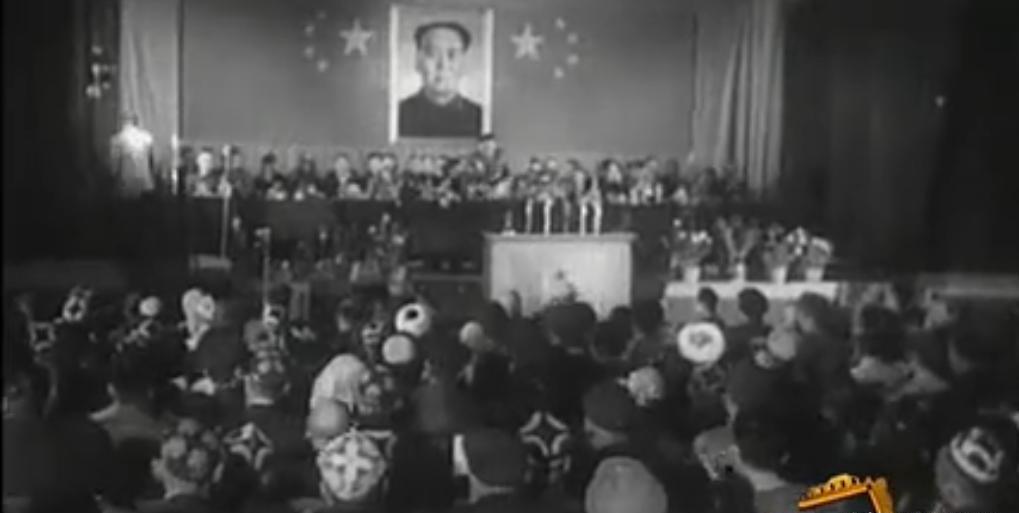
China claims that mass detention, forced labor, forced assimilation, cultural erasure, and genocidal policies in East Turkistan, what Beijing calls “Xinjiang (New Territory),” are necessary to combat “terrorism.” That claim rests on a state narrative that presents repression as security while stripping the territory’s native peoples of any recognized political right to self-determination.
China did not always describe resistance in East Turkistan this way.
In the decade following China’s military occupation of the territory, Chinese state media and officials openly acknowledged that opposition to Beijing’s rule was political: an independence struggle rooted in sovereignty and national self-determination. Only later, after native leadership was dismantled and colonial control consolidated, did the Chinese state reclassify that same resistance: first as “local nationalism,” then “separatism,” and eventually “terrorism.”
This reframing was not semantic. It laid the groundwork for the ongoing colonization of East Turkistan and for genocidal policies now justified in the language of “counterterrorism.” Tracing how this shift occurred clarifies how today’s system of repression emerged and why it persists.
Military invasion and occupation
On October 12, 1949, Chinese Communist forces invaded East Turkistan, less than two weeks after the founding of the People’s Republic of China. By December 22 of that year they had overthrown the independent East Turkistan Republic and imposed full military occupation.
At the time of the occupation, the Chinese colonists, largely soldiers, cadres, and civil servants, made up approximately 3–4 percent of the population. The overwhelming majority were Uyghurs, followed by Kazakhs, Kyrgyz, and other Turkic peoples. Resistance to occupation emerged immediately and was widely understood, including by Beijing, as political opposition.
Chinese government news reports from the early 1950s described sweeping campaigns against “counter-revolutionaries” and “enemies of China.” State media later acknowledged that approximately 150,000 people were killed in East Turkistan between 1949 and 1954 during these campaigns. Targets included political leaders, religious figures, intellectuals, wealthy individuals, and community organizers—precisely those capable of articulating collective political demands.
These early purges were designed to destroy the institutional foundations of self-rule while preserving the appearance of political normalization under Chinese control.
The autonomy framework as colonial consolidation
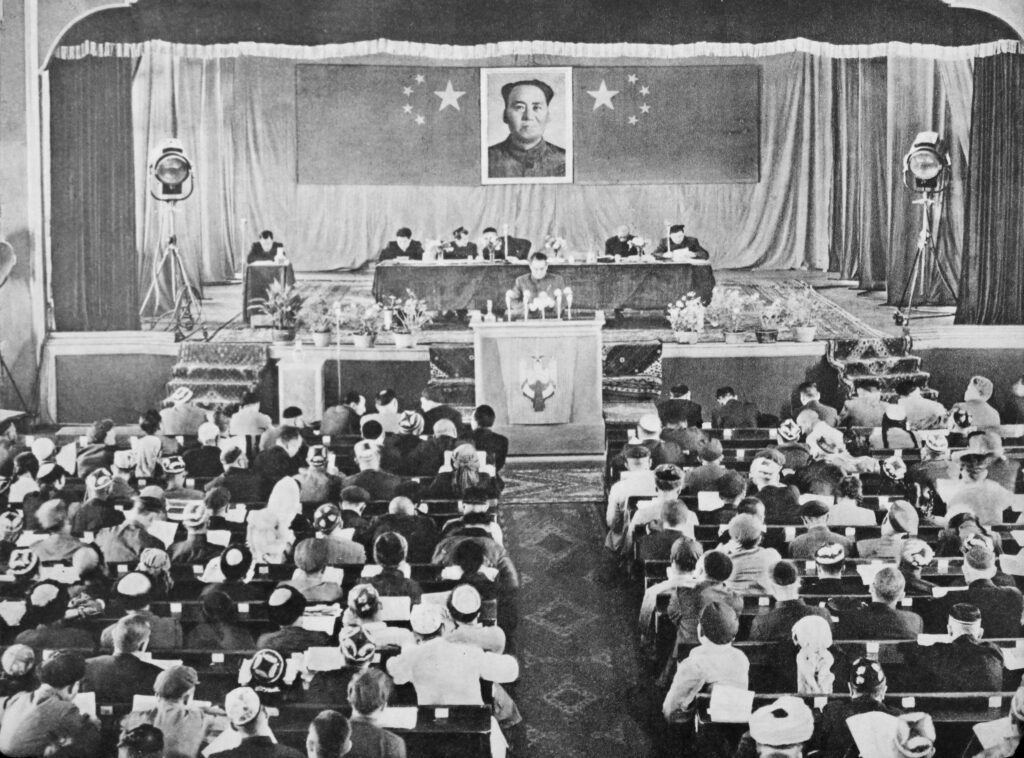
In 1955, Beijing unilaterally designated East Turkistan as the “Xinjiang Uyghur Autonomous Region” (XUAR). Internationally, the move was presented as evidence of local self-governance. In practice, political and military power remained firmly in the hands of the Chinese Communist Party, with key posts held by Han Chinese officials accountable directly to Beijing.
For East Turkistan’s native peoples, autonomy did not resolve the issue of self-determination. It obscured them. Independence, not administrative autonomy, remained the central political demand, reinforced by global decolonization movements reshaping Asia and Africa at the time.
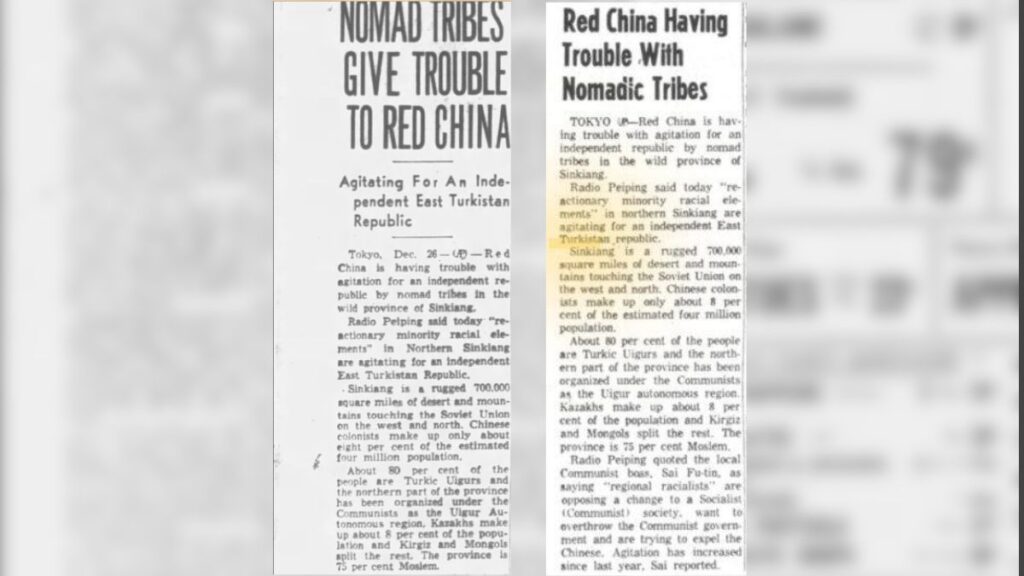
Chinese state media acknowledged this reality. In December 1957, official broadcasts cited by the Associated Press reported that large segments of the population were advocating for the restoration of an independent East Turkistan Republic.
“Reactionary minority racial elements … are agitating for an independent East Turkistan Republic.”
— Radio Peking, quoted by the Associated Press, Dec. 26, 1957
The report emphasized demographic reality: the population was overwhelmingly Turkic and Muslim, with Uyghurs comprising roughly 80 percent. Crucially, Chinese authorities did not describe this resistance as “terrorism” or “extremism.” They framed it as a political and ideological challenge, labeling it “regional nationalist ideology” or “local nationalism.”
Eliminating native political leadership
Following these admissions, Beijing moved to eliminate organized political resistance. From 1957 to 1960, the Anti-Rightist Campaign in East Turkistan targeted Uyghur, Kazakh, and other Turkic officials.
The Ürümchi plenum, convened in late 1957, became the center of this purge, with similar meetings followed in other cities, extending the campaign across the territory. By official counts, more than 1,600 East Turkistani cadres and intellectuals were labeled “local nationalists,” expelled from the Communist Party, imprisoned, or sent to “re-education” and forced labor. Many more were detained beyond official tallies.
Prominent political figures died in custody or under suspicious circumstances. The purpose of the campaign was clear: to eliminate a native political leadership capable of articulating independence demands in institutional or international terms.
From political struggle to “terrorism”
The political demand for independence did not disappear. What changes was how the Chinese state described it.
From the 1950s through the 1970s, resistance was labeled “local nationalism” or “counter-revolutionary activity.” In the 1980s and 1990s, it was increasingly reframed as “separatism.” After 2001, Beijing folded East Turkistan into its global “war on terror” narrative, reclassifying the same struggle as “terrorism.”
Each redefinition expanded the Chinese state’s claimed right to use coercion while narrowing the space for legitimate political expression. The objective remained constant: to deny East Turkistan’s right to self-determination by stripping its resistance of political meaning.
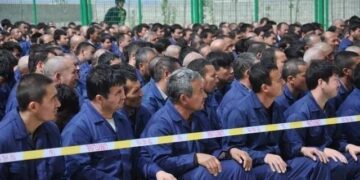
As Chinese colonial domination deepened, demographic engineering accelerated. Chinese colonists grew from a tiny minority in 1949 to more than 40 percent of the population by 2020, according to official census data. Uyghurs, who made up over 90 percent, fell to roughly 45%. Human rights organizations report that this transformation has been accompanied by mass detention, forced labor transfers, family separation, and coercive population control—practices that have been formally recognized as genocide and crimes against humanity by multiple governments and parliaments, and cited as crimes against humanity by United Nations.
Why this history matters
More than seven decades after the occupation began, international bodies and human rights organizations continue to warn that genocide against Uyghurs and other Turkic peoples is ongoing. The historical record shows that today’s policies are not a sudden response to new threats.
The consequences of earlier purges are not confined to the past. Since May 2014, with the launch of the ongoing genocide, political, cultural, and intellectual figures in East Turkistan have been subjected to an intensive campaign targeting so-called “two-faced people” (liangmian ren), accused of belonging to a “two-faced faction” (liangmian pai). Chinese state media portray these individuals as a major obstacle in the fight against “terrorism,” “separatism,” and “religious extremism,” with near-daily denunciations in official outlets.
Available reporting indicates that those targeted are overwhelmingly low-ranking Uyghur officials whose supposed disloyalty is often linked to personal religious observance later in life. This campaign has not functioned as routine party discipline. It operates as a mechanism of ongoing genocide, purging native officials, criminalizing religious and cultural identity, and eliminating any remaining native presence within governing institutions. In this way, the “two-faced people” campaign directly extends earlier purges and forms part of the contemporary system of mass detention, forced assimilation, and erasure.
China once openly acknowledged that resistance in East Turkistan was a struggle for independence. The later shift to the language of “terrorism” reflects not a change in that struggle, but a strategic decision to criminalize it in order to foreclose any claim to self-determination.
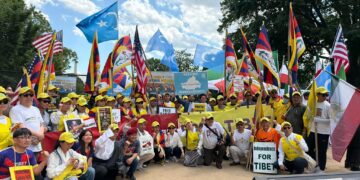
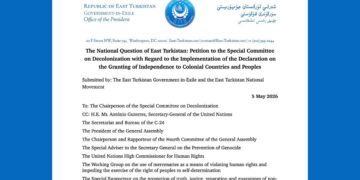
That understanding continues to shape contemporary political demands. The East Turkistan Government in Exile maintains that decolonization, independence, and national self-determination are the only viable means of guaranteeing fundamental human rights, cultural survival, and existence for the peoples of East Turkistan.
Seen in this light, the reframing of East Turkistan’s independence struggle was not merely rhetorical. It laid the ideological foundation for an ongoing system of domination—one that continues to deny a people their political rights while presenting their erasure as governance and “counter-terrorism.”

