




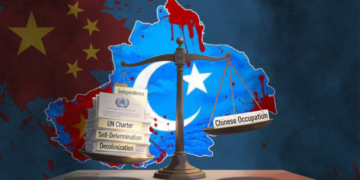


A profile examining his political role and how it is interpreted in exile today
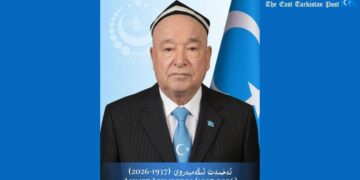
The legacy of Isa Yusuf Alptekin remains a point of sharp political contention among East Turkistanis in exile, not because the historical record is unclear, but because that record has been interpreted in fundamentally different ways by competing political currents.
Organizations such as the World Uyghur Congress (WUC) present Isa Yusuf as a “legendary leader” of the East Turkistan cause and a moral guide for contemporary advocacy. Independence advocates, including the East Turkistan Government-in-Exile (ETGE), reject that portrayal, arguing it obscures a documented history of opposition to East Turkistan’s independence and alignment with Chinese colonial rule.
The disagreement reflects deeper questions about resistance, collaboration, and the political future of East Turkistan, what Beijing calls “Xinjiang (New Territory),”.
Early political career within Chinese state structures
Isa Yusuf Beg oghli was born in 1901 in Kashgar into a family connected to the Chinese colonial administration. From the outset of his political life, he worked within Chinese state institutions rather than independence-oriented movements among East Turkistan’s native peoples.
In the late 1920s, while employed as an interpreter at Chinese consulates in Andijan and Tashkent, Isa Yusuf was approached by Uyghur merchants discussing plans to obtain Soviet arms to challenge Chinese rule. In his 1985 memoir, he later acknowledged reporting these conversations to Chinese officials, disrupting anti-colonial organizing at a formative stage.
In 1932, he was brought to Nanjing and appointed an adviser in the Border Affairs Office of China’s Ministry of Defence, a body central to frontier governance. This role placed him inside the Chinese state’s security and colonial apparatus overseeing East Turkistan.
Opposition to East Turkistan’s republics
When the First East Turkistan Republic was established in Kashgar between November 1933 and April 1934, Isa Yusuf opposed it from within the Chinese political system. In his publication Chinese Turkistan, he described the republic as “a foreign-engineered disturbance aiming to split China,” echoing official Chinese narratives and rejecting the republic’s legitimacy as an act of national self-determination.
For his continued loyalty, Isa Yusuf was appointed to China’s National Assembly in 1936. After Japan’s invasion of China, he relocated with the Chinese government to Chongqing, where he became involved in international advocacy on China’s behalf.
Between 1938 and 1939, Isa Yusuf travelled through India, Egypt, Syria, Türkiye, and other Muslim-majority societies, presenting China as the sole legitimate authority over East Turkistan while actively countering independence-oriented exile activism.
Undermining independence networks in exile
Chinese authorities also relied on Isa Yusuf to weaken East Turkistani independence leaders operating abroad. In 1938, Mahmut Muhiti publicly accused Isa Yusuf in the pro-independence journal Yash Turkistan of attempting to persuade exile leaders to abandon the independence struggle in exchange for wealth and official positions.
When those efforts failed, Isa Yusuf and Chinese representatives in Mumbai reported Muhiti and other independence figures to British authorities as “Japanese agents,” leading to arrests that significantly disrupted exile organizing.
A similar pattern followed in 1940 involving Muhammad Emin Bugra, who was detained by British authorities after refusing to relocate to Chongqing under Chinese auspices and later compelled to operate within Chinese-controlled political structures.
Independence advocates argue these episodes show how Isa Yusuf functioned as an intermediary used to fracture and neutralize the independence movement rather than advance it.
The “Three Effendis” and the post-1944 settlement
On 12 November 1944, East Turkistanis again asserted independence with the establishment of the Second East Turkistan Republic in the Ili region. Chinese forces were unable to defeat the new state militarily and instead pursued a political strategy.
Isa Yusuf Alptekin, Mesut Sabri, and Muhammad Emin Bugra were sent to Ürümchi to lead a Chinese-controlled provincial administration. Among East Turkistanis, the trio became known as the “Three Effendis.”
The independent East Turkistan Republic rejected them outright. Contemporary documents issued by the republic in 1946—later translated and archived by the United States Department of State—described figures aligned with Chinese rule as “spies,” “traitors,” and “puppets.”
How his legacy is invoked in exile politics
After resettling in Türkiye in the 1950s, Isa Yusuf remained influential in exile circles. Critics say he sought to dominate representation of the East Turkistan cause and marginalize independence-oriented positions in favour of autonomy-based frameworks compatible with Chinese state narratives.
In 1963, an open letter signed by Cengiz Turan, Hasan Oraltay, Ziyaddin Babakurban, and Sultan Tuğrul accused Isa Yusuf of undermining the independence struggle and suppressing dissent within exile communities.
Despite this record, the World Uyghur Congress has repeatedly portrayed Isa Yusuf as a “legendary leader” and framed its mission as a continuation of his political vision. In commemorative statements issued in recent years, the organization has described him as a lifelong advocate for freedom, dignity, and human rights.
Independence advocates reject this framing. They argue that such portrayals amount to political collaboration rather than resistance and mirror strategies historically used by Chinese authorities to neutralize independence movements by reframing engagement within colonial state structures as national advocacy.
Critics further argue that framing autonomy and human-rights advocacy under Chinese sovereignty as national struggle has historically functioned to delay decolonization while allowing Chinese control to deepen. From this perspective, the continued reverence for Isa Yusuf reflects a political lineage opposed to full independence, carried forward in exile under new terminology.
Why this debate matters
For independence advocates, the argument over Isa Yusuf Alptekin’s legacy is not about personal reputation. It is about whether historical memory clarifies or obscures the distinction between resistance and collaboration.
They argue that how figures like Isa Yusuf are remembered directly shapes contemporary political strategies—and determines whether the struggle for East Turkistan’s future is oriented toward full decolonization or remains confined within frameworks established by Chinese colonial rule.

