




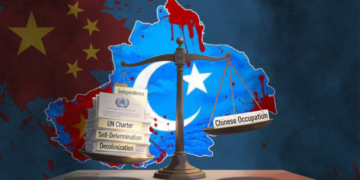


Summary: Academic review finds ETGE magazine compiles detention data, testimony, and global policy responses.
By The East Turkistan Post Staff | April 15, 2026
WASHINGTON — East Turkistan, what Beijing calls ‘Xinjiang (New Territory),’ is the subject of a new academic review. Researchers have analysed The Voice of East Turkistan, a publication by the East Turkistan Government in Exile (ETGE). The review found the magazine compiles two years of human rights allegations alongside records of international diplomatic responses.
The report evaluates how the publication documents detention systems, population policies, and labour programmes. It also assesses the magazine’s role in shaping external awareness and policy discussions. The publication draws on satellite imagery, survivor testimony, and policy analysis to present its findings.
Publication documents detention systems and population policies
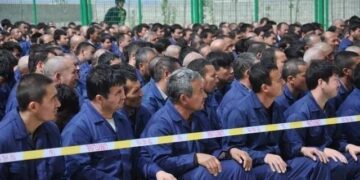
According to the review, The Voice of East Turkistan compiled data on detention infrastructure using satellite analysis and open-source research. It referenced findings from institutions such as the Australian Strategic Policy Institute, which has mapped facilities across East Turkistan.
The magazine also cited testimonies from former detainees describing detention conditions and administrative practices. These accounts appear alongside references to leaked documents and government directives. However, independent verification remains limited due to restricted access inside East Turkistan.
The publication further addressed population policies. It cited historical records and research discussing birth control measures implemented over several decades. Analysts note that researchers and governments have interpreted such claims in varying ways.
‘Mothers are the pedestal of nations,’ an ETGE statement cited in the publication said, in reference to its interpretation of population policies.
The review also notes that the publication references historical nuclear testing conducted at Lop Nur between 1964 and 1996. The magazine links those tests to long-term health concerns reported by researchers in the territory.
Labour programmes, economic systems, and cultural sites examined
The report highlights how the publication documents labour transfer programmes and industrial systems in East Turkistan. It cites research connecting supply chains to global industries. Findings from the Australian Strategic Policy Institute on manufacturing and labour practices are among the sources referenced.
The publication also examines the role of the Xinjiang Production and Construction Corps, known as Bingtuan, in managing economic activity. According to the review, the magazine describes the organisation’s involvement in agriculture, resource extraction, and infrastructure development across East Turkistan.
Cultural and religious sites form another area of focus. The review notes that the publication uses satellite imagery to document changes to mosques, cemeteries, and other locations of cultural significance. These findings are presented within broader discussions on cultural preservation, though access limitations continue to affect independent verification.
International responses tracked alongside legal developments
The report states that The Voice of East Turkistan tracks international reactions to developments in East Turkistan. These include legislative and diplomatic actions such as the Uyghur Human Rights Policy Act and sanctions imposed by governments on specific officials and institutions.
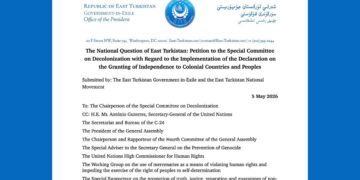
The publication also documents formal statements issued by national parliaments and governments on conditions in East Turkistan. These appear alongside discussions of international legal efforts, including submissions to global judicial bodies.
Additionally, the review notes that the publication reports on policy designation changes. These include the removal of the East Turkistan Islamic Movement from certain government lists. Some policymakers said the change reflected reassessments of available evidence.
Review notes verification constraints across information environment
According to the academic analysis, The Voice of East Turkistan functions as a centralised archive of claims, testimonies, and policy tracking related to East Turkistan. The report states that policy discussions, academic work, and advocacy efforts have referenced its materials.
The review concludes that while the publication contributes to documentation efforts, the broader information environment remains constrained. Limited independent access to East Turkistan means that much available information relies on indirect methods, including satellite imagery, diaspora testimony, and secondary data analysis.
Chinese authorities maintain that policies in East Turkistan promote economic development, poverty reduction, and counter-extremism. Officials have rejected allegations of abuse. Independent verification remains restricted for journalists, researchers, and international observers.
The East Turkistan Post is an independent news publication. All claims are attributed to their respective sources. Access restrictions inside East Turkistan limit independent on-the-ground verification.
