
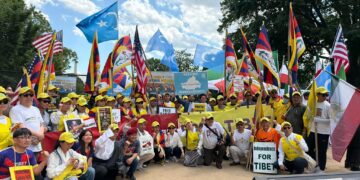
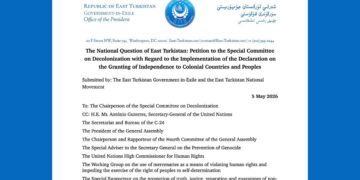




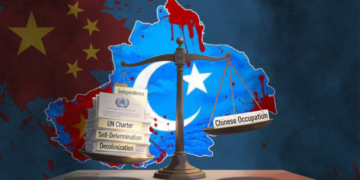


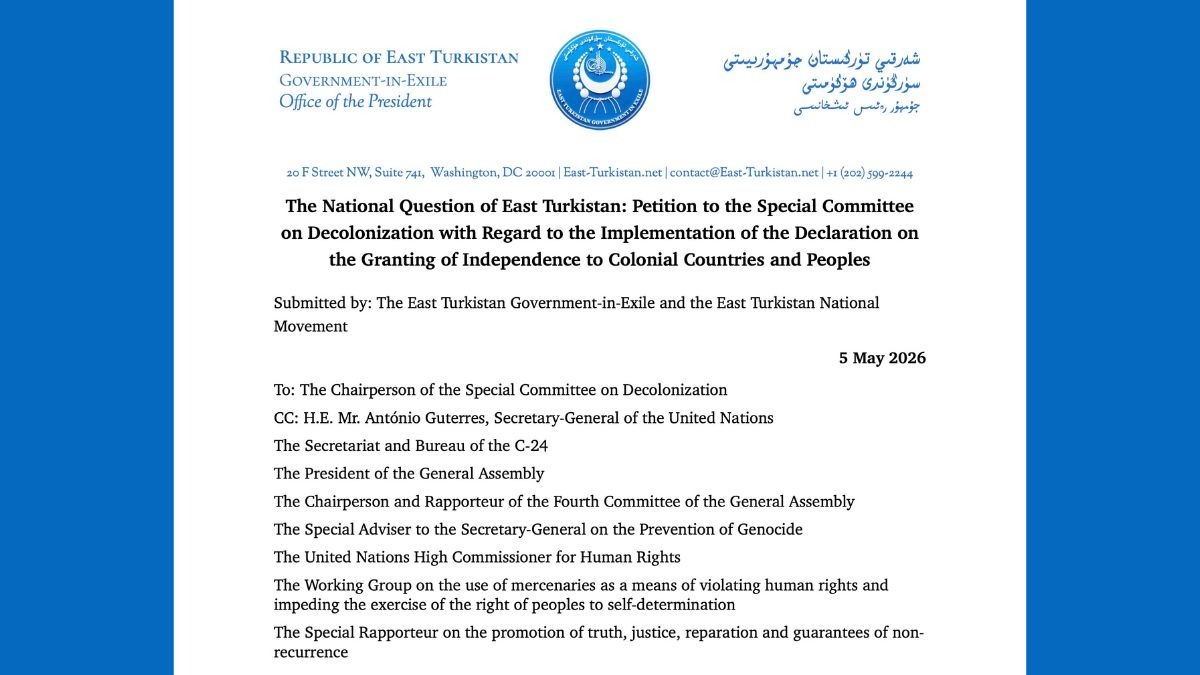
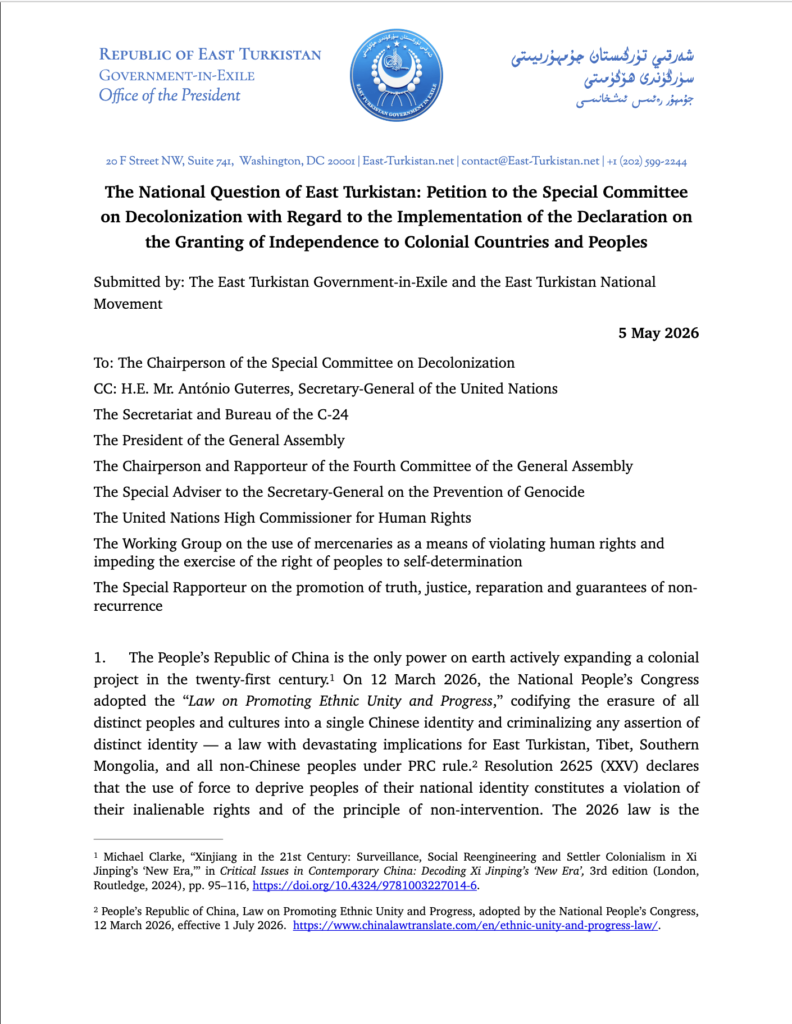
WASHINGTON — East Turkistan, what Beijing calls ‘Xinjiang (New Territory),’ is now the subject of a formal East Turkistan decolonization petition at the United Nations. The East Turkistan Government in Exile (ETGE) and the East Turkistan National Movement filed the document with the UN Special Committee on Decolonization (C-24). They request East Turkistan’s listing as a Non-Self-Governing Territory. Moreover, the filing seeks to activate a UN self-determination framework after other mechanisms have not produced results.
The ETGE states this is the first formal challenge to China as a colonial power before a UN body. Furthermore, petitioners argue no legal transfer of sovereignty occurred when Chinese forces entered the territory in 1949.
East Turkistan decolonization case rests on statehood and demographics
The filing asserts that Chinese administration amounts to occupation without consent. According to the ETGE petition, the East Turkistan Republic existed before 1949 and met statehood criteria under the 1933 Montevideo Convention. Those criteria include a permanent population, defined territory, and a functioning government.
ETGE documents claim Chinese settlers grew from under 5 percent of the population in 1949 to over 42 percent today. In addition, petitioners state the native Turkic population share fell from over 90 percent to around 55 percent in the same period. These demographic figures come from the ETGE petition. They have not been independently verified.
The ETGE and ETNM describe state-directed settlement as a tool of population control. Chinese authorities had not issued a direct response to the petition at the time of publication.
For background, see our earlier report on demographic changes in East Turkistan.
East Turkistan decolonization bid follows failed human rights efforts
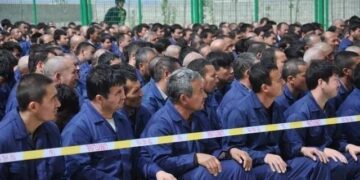
The petition follows what the ETGE calls the failure of existing human rights frameworks to resolve the East Turkistan decolonization question. It references the UN Office of the High Commissioner for Human Rights’ 2022 report, which found Chinese actions may constitute crimes against humanity.
The filing also cites five evidence submissions to the International Criminal Court since 2020. No formal investigation has opened. It further references China’s March 12, 2026 Law on Promoting Ethnic Unity and Progress. The ETGE describes this law as codifying cultural assimilation policies.
Chinese officials maintain that policies in East Turkistan comply with domestic law and promote development. State media has previously described such laws as supporting social stability.
See also our report on China’s ethnic unity law for further context.
UN recognition sought through eight formal requests
The 25-page petition lists eight requests to the UN General Assembly. These include designating China as an occupying power. They also include affirming East Turkistan’s right to self-determination. Additionally, the petition asks the UN to examine China’s role on the Security Council and the decolonization committee itself.
The ETGE describes East Turkistan as the world’s largest colonial territory by both population and area.
“More than eighty nations achieved their independence through the decolonization framework,” said Dr. Mamtimin Ala, ETGE President. “Today, the peoples of East Turkistan formally assert that same right before the United Nations.”
Salih Hudayar, ETGE Foreign Minister said that decolonization offers the only guarantee for the native population’s survival and human rights. Therefore, the ETGE states that sovereignty restoration is the fundamental solution for East Turkistan.

