






China cites development gains while exile groups allege exploitation and cultural suppression.
By The East Turkistan Post Staff | April 15, 2026
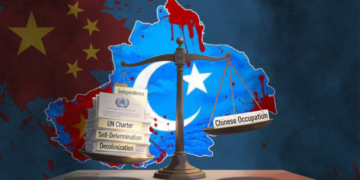
WASHINGTON — East Turkistan, what Beijing calls ‘Xinjiang (New Territory),’ is at the centre of sharply diverging narratives between Chinese state authorities and Uyghur exile groups. Beijing highlights economic growth and stability. Exile organisations allege exploitation and cultural suppression. Meanwhile, global parliaments continue to debate recognition of alleged abuses, with implications for international relations and sanctions policy.
China cites development gains; exile groups allege resource extraction
Chinese authorities claim infrastructure projects have lifted 2.3 million people from poverty, with gross domestic product growth of 7 percent, according to state media reports. Beijing frames these figures as evidence of successful governance and long-term development in East Turkistan.
Exile organisations, including the East Turkistan Government in Exile (ETGE), describe these developments as colonial extraction. They cite East Turkistan’s role in supplying 30 percent of China’s onshore oil, 34 percent of its natural gas, and 45 percent of global polysilicon output, according to data from the US Energy Information Administration and industry analyses.
Chinese state media portrays administrative changes, including new county designations such as Cenling, as measures supporting security and stability. Officials cite separatism threats as justification, according to official statements.
The ETGE has condemned such changes as tools to alter demographic composition. The group states in public releases that Han population migration targets of 25 percent are being pursued through these administrative measures. Beijing has said such changes are aimed at ensuring long-term peace and social cohesion.
Detention claims and surveillance systems disputed
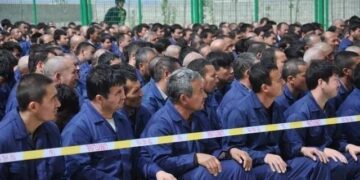
Chinese authorities describe facilities in East Turkistan as vocational training and de-radicalisation centres. Officials have consistently rejected foreign criticism of these programmes as politically motivated and biased.
Exile groups reference leaked documents, including the Xinjiang Papers and the Xinjiang Police Files, to support estimates of between 1.8 million and 3 million detentions. The Australian Strategic Policy Institute has published research on the Integrated Joint Operations Platform, a surveillance system used in East Turkistan, and has documented interrogation practices reported by former detainees.
‘Vocational training’ centres are described by Beijing as educational facilities operating within domestic law.
The ETGE and other exile organisations have lobbied for genocide recognition in the legislatures of the United States, United Kingdom, Canada, the Netherlands, Lithuania, and France. They cite a reported 60 percent drop in birth rates, which they attribute to forced sterilisation policies, drawing on UN assessments and Amnesty International reports. China has called such characterisations politically motivated interference in its internal affairs.
Cultural and environmental claims remain contested
Beijing promotes tourism in East Turkistan as evidence of multi-ethnic harmony and cultural preservation. State campaigns present maintained heritage sites as proof of protection policies.
The Australian Strategic Policy Institute has documented changes to approximately 16,000 mosques since 2017, representing around 65 percent of the total, including damage or demolition. Exile groups state that religious practices such as fasting have been labelled as indicators of extremism by authorities. Chinese officials have not directly addressed the mosque figures published by the institute.
On environmental matters, Beijing promotes ecological initiatives including wetland conservation. Exile perspectives, including those of the East Turkistan World Congress, reference environmental concerns such as glacier recession and the historical drying of Lop Nur lake. Historical reports also document 46 nuclear tests conducted at Lop Nur, which researchers have linked to long-term health concerns among surrounding populations.
International sanctions and monitoring continue
International bodies continue to monitor developments in East Turkistan. Sanctions targeting entities including the Xinjiang Production and Construction Corps have been imposed by the United States and other governments. Exile groups maintain protest activity in cities including Washington, Edmonton, and Melbourne, marking dates such as the Baren Uprising anniversary.
Chinese authorities have not altered their public position, maintaining that policies in East Turkistan serve legitimate development, security, and governance objectives. Independent verification of conditions inside East Turkistan remains restricted for foreign journalists, researchers, and international observers.
The East Turkistan Post is an independent news publication. All claims are attributed to their respective sources. Access restrictions inside East Turkistan limit independent on-the-ground verification.
