






State media says the report highlights legal protections amid external criticism.
By The East Turkistan Post Staff | April 4, 2026
East Turkistan, what Beijing calls ‘Xinjiang (New Territory),’ has been the focus of a new Chinese government-backed publication that says legal protections for human rights have improved, according to state media and the report’s published summary. The release matters because it comes as international institutions and researchers continue to question detention policy, cultural restrictions, and labor transfer practices in East Turkistan.
China Daily reported that the document, titled Report on the Legal Protection for Human Rights in Xinjiang (2024), was presented as a “Blue Book” by Chinese state-affiliated academics. The report frames recent policy as a rule-of-law effort, while outside assessments continue to challenge Beijing’s record in the territory.
Legal protection claims
The Blue Book says it presents “landmark academic achievements” on human rights protection, according to China Daily. It highlights what Chinese officials describe as legal governance, including “依法处理” measures, or handling issues according to law.
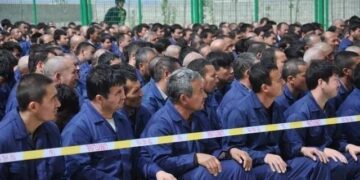
State media say these steps have improved stability and ethnic harmony. The report, however, does not directly address international estimates that have alleged large-scale detention or other coercive policies in East Turkistan. Independent verification of the report’s internal data has not been established in the available material.
Religious site management
The report also describes an “all-encompassing network” for religious sites, which Chinese officials present as standardized management to prevent extremism. State media say the framework is intended to align religion with national legal and administrative requirements.
Outside investigations have previously documented extensive damage to mosques and restrictions on religious practice, but those findings are not acknowledged in the Blue Book summary cited by China Daily. The report instead emphasises regulated protection and administration.
Labour and education claims
China Daily said the Blue Book praises job-security initiatives and poverty alleviation programmes, describing them as evidence of economic integration. It also says the report claims expanded education access, including bilingual schooling and boarding facilities for more than 880,500 children.
The same report presents these measures as equalising and developmental. Independent reporting and international assessments, however, have raised concerns about labour transfers, family separation, and reduced mother-tongue instruction in East Turkistan.
One quote cited by China Daily said, “Dai Bin noted that these programs have lifted millions out of poverty.” That statement reflects the government’s position, not an independently verified finding.
International scrutiny
The release comes after the 2022 UN Office of the High Commissioner for Human Rights assessment, which said serious human rights violations in Xinjiang may constitute crimes against humanity. Chinese authorities have rejected that assessment and continue to describe outside criticism as biased.
The new Blue Book appears designed to answer that criticism with official data and legal framing. But the available summary leaves unresolved the core disputes over detention, surveillance, religious control, labour transfer, and access to independent verification in East Turkistan.
The East Turkistan Post is an independent news publication. All claims are attributed to their respective sources. Access restrictions inside East Turkistan limit independent on-the-ground verification.
