




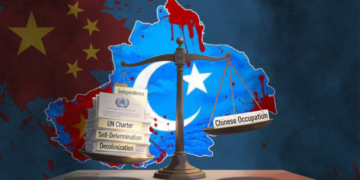


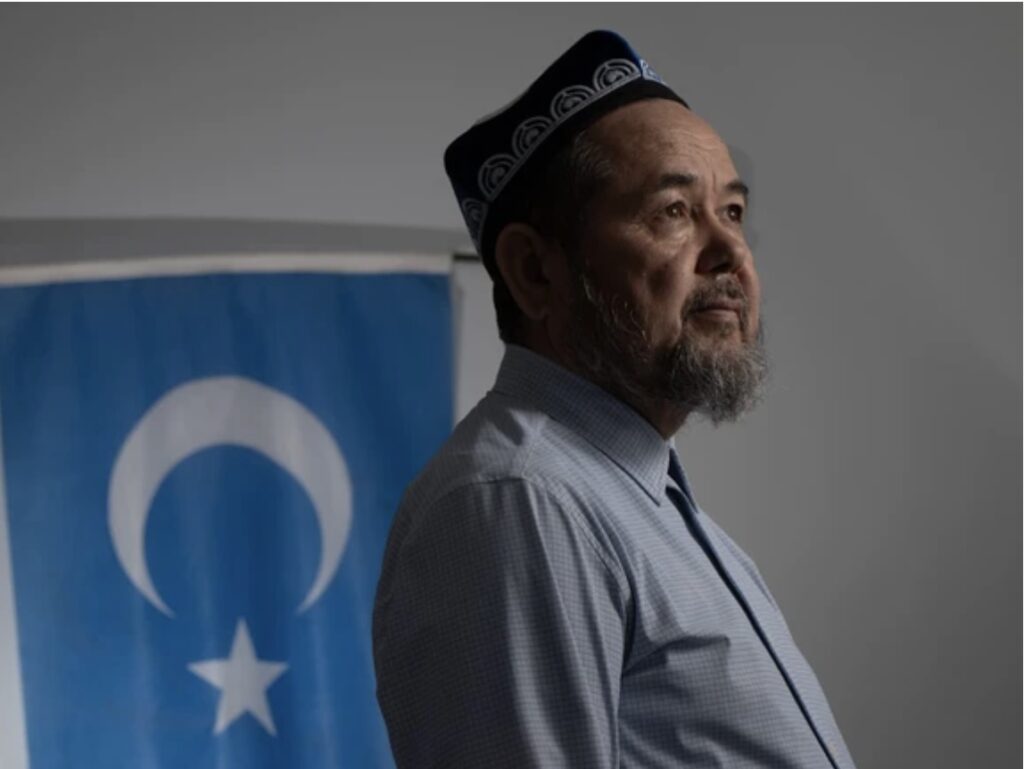
Abdulahat Nur calls on world leaders to confront Beijing over alleged occupation and restore East Turkistan independence.
By The East Turkistan Post | May 22, 2026
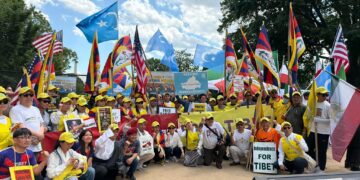
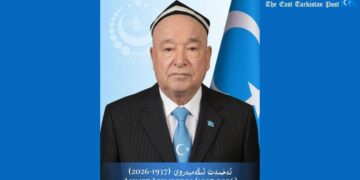
EDMONTON — East Turkistan, what Beijing calls ‘Xinjiang (New Territory),’ is the focus of a renewed diplomatic push for East Turkistan independence by Abdulahat Nur, Prime Minister in Exile of the East Turkistan Government in Exile (ETGE). Nur is calling on governments and international institutions to move beyond symbolic statements. The ETGE says the campaign links political status, human rights, and international accountability directly to the question of sovereignty.
Nur, who works as a school bus driver in Edmonton, Canada, said the ETGE sees East Turkistan independence as the only viable path for the survival of Uyghur, Kazakh, Kyrgyz, and other Turkic peoples. His remarks came as the ETGE continues to press for decolonization oversight at the United Nations.
From underground schooling to leading East Turkistan independence campaign
Nur was born on June 10, 1967, in Maralbeshi County, according to ETGE material. He said he left the state school system as a child after restrictions on teaching native language and history. He later studied at an underground national school. The ETGE says he faced years of harassment before leaving East Turkistan and arriving in Canada in 2001.
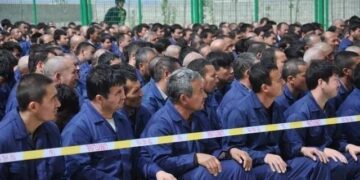
As Prime Minister in Exile, Nur has become one of the ETGE’s key international advocates. The group says he has spoken before parliaments and public forums about mass internment, systemic abuses, and the political status of East Turkistan. Those claims are presented here as ETGE assertions and have not been independently verified by The East Turkistan Post.
For background, see our earlier report on the ETGE’s UN decolonization petition.
UN petition central to East Turkistan independence strategy
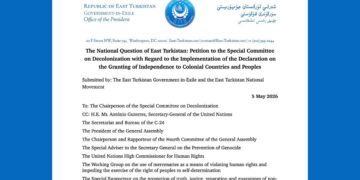
A central part of the ETGE’s current campaign is its petition to the UN Special Committee on Decolonization, submitted on May 5, 2026, together with the East Turkistan National Movement. The 25-page filing asks the UN General Assembly to designate China as an occupying power. It also asks the UN to recognise East Turkistan as a Non-Self-Governing Territory.
The ETGE says the petition is the first formal attempt to bring East Turkistan’s status before the UN decolonization process. Furthermore, the organisation argues that China’s administration has no legal legitimacy. It also states that the 1955 Xinjiang Uyghur Autonomous Region designation masked consolidated political control. These are the ETGE’s legal arguments and are not conclusions independently reached by The East Turkistan Post.
Nur has additionally urged the United States to treat East Turkistan in the same way as Tibet. This includes formal recognition of occupied status and the appointment of a State Department coordinator for East Turkistani issues. The ETGE says such steps would align US diplomatic action with the group’s push for international oversight.
See also our report on ETGE appeals to US Congress alongside Tibetan groups.
ETGE frames East Turkistan independence as strategic and economic necessity
The ETGE frames East Turkistan independence not only as a human rights issue but also as a strategic matter. The group says the territory is central to China’s Belt and Road Initiative. It also provides key energy and infrastructure links for Beijing’s regional ambitions.
Nur and other ETGE leaders say East Turkistan contains important deposits of lithium, zirconium, and rare earth elements vital to high-tech and defence industries. They argue that an independent East Turkistan could supply these materials to Western partners under new political arrangements. These resource and security claims come from ETGE documentation and have not been independently verified by The East Turkistan Post.
The ETGE also says it continues to submit evidence to the International Criminal Court in an effort to hold senior Chinese officials accountable. The group argues that justice cannot be achieved without decolonization. Moreover, it states that international silence would allow demographic engineering and political control to deepen.
‘Our position is clear and unwavering,’ Nur said in a statement quoted by the ETGE. ‘East Turkistan was an independent nation. It remains an occupied country. The ETGE will continue to lead our people’s struggle until full independence and sovereignty are restored.’
Chinese authorities have consistently rejected allegations of colonial occupation and human rights abuses in East Turkistan. Officials describe their policies as lawful and aimed at stability and development, according to Chinese state media and official statements.
The East Turkistan Post is an independent news publication. All claims are attributed to the ETGE or named individuals. Demographic, resource, and legal assertions are reported as the organisation’s positions. Access restrictions inside East Turkistan limit independent on-the-ground verification.
