




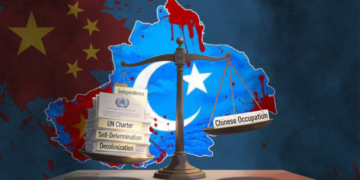



Summary: Exile government warns new Chinese law expands legal basis for assimilation policies targeting native peoples.
By The East Turkistan Post Staff | April 15, 2026
WASHINGTON — East Turkistan, what Beijing calls “Xinjiang (New Territory),” is facing renewed scrutiny. The East Turkistan Government in Exile (ETGE) has condemned China’s new Ethnic Unity and Progress Promotion Law. The group warns the law expands policies targeting native identity, language, and social life.
The ETGE released its statement on March 12. The Washington-based exile government said the law locks in governance practices already applied across East Turkistan. Furthermore, it stated that Beijing uses ethnic unity narratives to justify linguistic standardisation, political indoctrination, and cultural restrictions.
What the law does, according to the ETGE
The ETGE says the law creates a broader legal framework. Consequently, enforcement tied to ideological conformity could expand significantly. The group also warns that provisions on ethnic unity harm may be applied widely. As a result, individuals could face punishment for cultural, linguistic, or religious practices.
“The law institutionalises policies that target the identity and social fabric of native peoples,” the ETGE said in its March 12 statement.
In addition, the statement connects the law to existing state policies. International researchers have documented these policies previously. They include labour transfer systems, demographic restructuring programmes, and state-directed social initiatives. Rights organisations have described them as part of a surveillance-centred governance model.
Risks for diaspora communities abroad
The ETGE also raised concerns beyond China’s borders. It warned the law could reinforce transnational pressure on diaspora communities. Moreover, researchers, journalists, and activists abroad may face greater risk. The group says expanded national unity justifications could be used against them.
In response, the ETGE called on governments to act. It urged targeted sanctions and stronger import controls tied to forced labour concerns. It also called for coordinated diplomatic measures. Additionally, it asked international institutions to assess the law under global human rights obligations rather than as an internal matter.
China’s position and access limits
Chinese authorities deny rights abuses in East Turkistan. They state that policies there promote economic development and social stability. Beijing has not responded directly to the ETGE statement on this law.
Meanwhile, independent verification inside East Turkistan remains limited. Foreign journalists, observers, and researchers have faced access restrictions throughout the period in question.
Finally, the ETGE called on the international community to treat East Turkistan as a site requiring multilateral human rights engagement and formal accountability measures.
The East Turkistan Post is an independent news publication. All claims are attributed to their sources. Access restrictions limit independent verification inside East Turkistan.
