



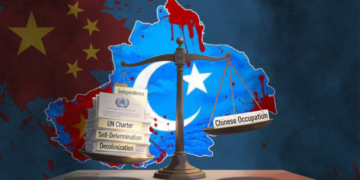


UN findings, trade measures, and research heightened concern from 2021 to 2025.
By The East Turkistan Post Staff | March 13, 2026
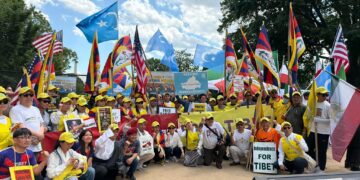
WASHINGTON — East Turkistan, what Beijing calls “Xinjiang (New Territory),” remained under sustained international scrutiny between 2021 and 2025, as a United Nations human rights assessment, trade restrictions, and academic research drew renewed attention to detention, surveillance, and cultural controls. The developments matter because they shaped global policy, supply-chain enforcement, and diplomatic debate over China’s rule in East Turkistan.
The period saw the publication of a landmark UN assessment, the expansion of forced-labour-related trade measures, and continued documentation by researchers of surveillance and restrictions on language and religion. China rejected all allegations and said its policies were legitimate counter-terrorism and development measures.
UN assessment
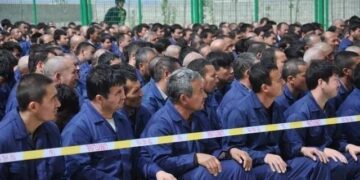
The most significant development came on August 31, 2022, when the UN Office of the High Commissioner for Human Rights released its long-awaited assessment of conditions in East Turkistan. The report documented arbitrary detention and discriminatory policies, and said the abuses it identified may amount to crimes against humanity under international law.
“Serious human rights violations have been committed in Xinjiang,” the UN assessment said, adding that the violations “may constitute international crimes, in particular crimes against humanity.”
China rejected the report and maintained that its policies in East Turkistan were aimed at counter-terrorism and stability. A later attempt to bring the findings to formal debate at the UN Human Rights Council in October 2022 failed. UN officials said in 2023 that no concrete progress had been made on the report’s recommendations.
Trade and labour measures
International concern also translated into trade policy. In 2021, the United States passed the Uyghur Forced Labor Prevention Act, which restricts imports linked to East Turkistan on the basis of forced labour allegations. The law marked a broader shift in which the issue became not only a human rights concern but also a supply-chain enforcement matter.
Academic research and government assessments during the period documented allegations of coercive work in sectors including textiles, cotton, and solar panel manufacturing. Later studies placed greater focus on forced labour, imprisonment, and the long-term use of detention-linked labour systems.
Researchers also argued that some detention structures had shifted from extra-judicial facilities to formal prisons. China has denied the allegations and said labour and training policies are part of economic development.
Surveillance and cultural restrictions
Researchers continued to document restrictions on language, religion, and cultural practice in East Turkistan. Reports in 2024 identified the renaming of hundreds of settlements as evidence of assimilation policies, according to the published academic literature.
Studies also described East Turkistan as one of the most heavily monitored territories in the world. The literature cited facial recognition systems, mobile device checks, and predictive policing tools as part of what researchers call digital authoritarianism.
The UN and other international bodies repeatedly called for transparent and independent access to East Turkistan during 2023 and 2024. By 2025, independent access remained limited, leaving many findings dependent on satellite imagery, published research, and restricted-source reporting.
Global policy impact
By 2025, the issue had become a matter of international geopolitics as well as human rights. The United States and several other governments imposed targeted sanctions on Chinese officials linked to policies in East Turkistan. Legislatures in the United States, Canada, the United Kingdom, and the Netherlands also passed motions or resolutions describing the situation as genocide, though legal scholars note those declarations are political and not binding judicial findings.
The academic record reviewed over the period points to broad agreement on the existence of an intense security system, the disproportionate impact on Uyghurs and other Muslim communities, and the state-level character of policies introduced after 2017. At the same time, researchers continue to disagree on the precise scale of detention and on the legal weight of genocide designations.
China has kept its public position unchanged, saying its policies serve security and development goals and rejecting foreign criticism as interference in internal affairs.
