




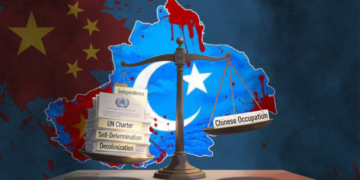


First and Second Republics sought recognition from multiple foreign powers between 1933 and 1949.
By The East Turkistan Post Staff | March 8, 2026
WASHINGTON — East Turkistan, what Beijing calls “Xinjiang (New Territory),” saw its First and Second Republics conduct documented diplomatic campaigns aimed at securing international recognition, according to historical records cited in exile government archives and other available documentation. The record matters because it is used by the East Turkistan Government in Exile to argue that both republics functioned as sovereign entities before the 1949 incorporation into the People’s Republic of China.
The available material describes passport issuance, currency, missions abroad, and direct correspondence with foreign governments as evidence of state capacity. Neither republic won broad formal recognition, and the records say geopolitical calculations by the Soviet Union and Nationalist China helped limit their diplomatic success.
First Republic missions abroad
The Islamic Republic of East Turkistan, declared on November 12, 1933, sent emissaries to the Soviet Union, Afghanistan, Sweden, Iran, Turkey, and British India, according to the historical record. The republic’s leadership also wrote directly to heads of state seeking recognition of its sovereignty.
In February 1934, a delegation led by Dr. Mustapha Ali travelled to New Delhi to seek recognition from British colonial authorities and the Indian government. The records also say the republic issued its own passports and currency during its short existence, which is presented as evidence of functioning administrative institutions.
Afghan officials under King Mohammed Zahir Shah reportedly adopted a position of neutrality toward the First Republic while selling arms to its forces and allowing Afghan volunteers to join the effort. The Soviet Union, by contrast, explicitly rejected recognition. Historical records say Moscow feared that recognising a Turkic state on its border could encourage similar movements inside Soviet-controlled Central Asia.
Chinese Nationalist forces, with Soviet assistance, overthrew the First Republic on April 16, 1934, roughly six months after its declaration.
Second Republic’s negotiations
The Second East Turkistan Republic, declared on November 12, 1944, maintained diplomatic activity for five years and fielded a National Army of about 40,000 troops, according to the records. Its leaders entered direct peace negotiations with the Republic of China, producing the January 1946 “Eleven Articles of Peace,” which proposed a coalition-style political arrangement.
President Ahmetjan Qasimi led a delegation to the Chinese National Assembly in Nanjing, while also appealing directly to Soviet leader Joseph Stalin for protection of East Turkistani interests. Historical documentation says the republic also pursued contacts with British India and Great Britain and continued to issue passports as part of its administrative practice.
One quoted historical record states: “The Soviet Union decided to sacrifice the Republic for its own national interests, signing a treaty with Nationalist China in August 1945 that pledged to cease all aid to the ETR.”
Soviet shift and collapse
The records link the republic’s decline to broader great-power diplomacy, including the 1945 Yalta framework and the Soviet treaty with Nationalist China that ended material support. That withdrawal removed the republic’s main external backing and sharply weakened its negotiating position.
The republic’s senior leadership left for Moscow on August 24, 1949, to attend the inaugural session of the Chinese People’s Political Consultative Conference. Soviet archival records say the aircraft crashed near Irkutsk, killing all 14 officials aboard. By December 22, 1949, units of the East Turkistan National Army had been absorbed into the People’s Liberation Army.
Chinese position and access limits
Chinese government sources maintain that the 1949 incorporation was a legitimate internal settlement within what Beijing designates the Xinjiang Uyghur Autonomous Region. Official Chinese documentation does not accept the claim that the 1944–1949 republic conducted independent foreign relations as a sovereign state.
The East Turkistan Government in Exile says the diplomatic missions, treaty talks, and passport issuance show separate sovereign capacity. Independent verification of some archival material remains limited because access inside East Turkistan is restricted.
Soviet, Chinese Nationalist, and exile archives remain the main sources available for historical analysis of the republics’ diplomacy.
