








Chinese authorities in East Turkistan, what Beijing calls “Xinjiang (New Territory),” are threatening residents with detention and prison sentences for downloading, sharing, or listening to a wide range of Uyghur-language songs, according to an investigation by the Associated Press.
The report is based on an audio recording of a meeting held last October by police and local officials in Kashgar, which AP said it obtained and verified. During the meeting, authorities warned residents that those found with banned songs stored on phones, computers, or online accounts could face punishment, including imprisonment. Officials also instructed attendees to avoid common Islamic greetings and replace them with phrases praising the Chinese Communist Party.
Among the songs flagged is “Besh pede,” a widely known Uyghur folk ballad traditionally played at weddings and family gatherings. Despite its lyrics focusing on love and faith, authorities classified the song as “problematic,” AP reported.
“I’m not at all surprised to hear these accounts of people either being threatened with detention or being detained or imprisoned for listening to the wrong music.”
— Rian Thum, University of Manchester
Cultural repression through music bans
AP reported that the policy was corroborated through interviews with former residents of East Turkistan, some of whom said relatives and acquaintances had been detained for playing or sharing Uyghur music. The agency also reviewed a court verdict sentencing a Uyghur music producer to three years in prison for uploading songs later deemed sensitive to a cloud storage account.
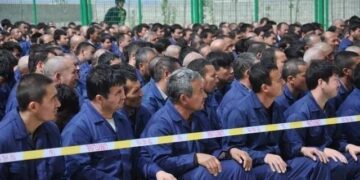
The crackdown forms part of a broader campaign targeting cultural and religious expression as part of China’s ongoing genocide against Uyghurs and other Turkic peoples. Between 2014 and 2019, millions of Uyghurs, Kazakhs, Kyrgyz, and other Turkic peoples were subjected to mass detention, according to governments and rights organizations. In 2022, the United Nations said abuses in East Turkistan may amount to crimes against humanity.
Chinese authorities maintain that their policies are aimed at combating terrorism and religious extremism. In a statement cited by AP, China’s Foreign Ministry said the government had acted “in accordance with the law” to safeguard stability, accusing “anti-China forces” of distorting policies in the territory. A local colonial official declined to substantively respond to AP’s request for comment.
Songs, surveillance, and punishment
According to AP, authorities identified seven categories of so-called “problematic” songs, ranging from traditional folk music to newer works circulating in the Uyghur diaspora. Some songs were flagged for religious references; others for allegedly “smearing” Communist Party rule.
Among those listed is “Atalar” (“Forefathers”), a well-known song by the Uyghur musician Abdurehim Heyit. The song, which honors Uyghur ancestors and collective memory, was accused of “inciting terrorism and extremism.” Heyit was detained during the height of China’s mass crackdown on Uyghur cultural figures; his current status remains unclear.
Ethnomusicologist Rachel Harris of SOAS University of London told AP that songs such as “Besh pede” and “Atalar” reflect common romantic, spiritual, and historical expression and do not incite violence. She said their targeting illustrates the state’s suspicion of religious and communal life.
The report details the case of Yashar Shohret (“Yashar Xiaohelaiti”), a 27-year-old Uyghur music producer sentenced in 2023 to three years in prison for producing and uploading dozens of songs later classified as problematic. AP also cited accounts of teenagers and ordinary residents being detained for sharing Uyghur songs on messaging apps.
Although Beijing claims large-scale repression has ended and that life has returned to normal, scholars told the Associated Press that the song bans indicate continued surveillance and normalized, long-term repression.
Genocide Watch recently issued a warning that genocidal policies targeting Uyghurs and other Turkic peoples are ongoing. A new Congressional-Executive Commission on China report states that mass surveillance, forced labor, forced assimilation, sterilization, and repression continue in East Turkistan, noting that the underlying structures enabling genocide remain in place.
Independent reporting inside East Turkistan remains severely restricted, limiting external scrutiny and making investigations such as the AP report rare.

