


Friday, April 17, 2026
No Result
View All Result
The East Turkistan Post
  • Home
  • News
    • All
    • East Turkistan
    • Exile
    • International

    Evidence mounts of systematic forced labour in East Turkistan

    Beijing and exile groups clash over East Turkistan narrative

    China’s power grid relies on East Turkistan resources

    East Turkistan briefing challenges China’s soft power claims

    China creates new divisions in East Turkistan, ETGE objects

    ETGE criticises China’s role in UN Islamophobia observance

    ETGE marks 81st anniversary of East Turkistan National Army Memorial Day

    ETGE marks 36th anniversary of Baren uprising with calls for international action

    ETGE rejects ‘Xinjiang’ as name for East Turkistan

  • Explainer
    • All
    • In-Depth
    Five years after genocide recognition, China’s campaign against Uyghurs and other Turkic peoples continues

    Five years after genocide recognition, China’s campaign against Uyghurs and other Turkic peoples continues

    How labeling Uyghurs a “minority” enables China’s denial of East Turkistani self-determination

    How labeling Uyghurs a “minority” enables China’s denial of East Turkistani self-determination

    Why Isa Yusuf Alptekin’s legacy has reignited divisions among East Turkistanis in exile

    CECC Report: China’s Genocide in East Turkistan Is Being Reorganized, Not Ended

    CECC Report: China’s Genocide in East Turkistan Is Being Reorganized, Not Ended

    How China Reframed East Turkistan’s Independence Struggle to Deny the Right to Self-determination

    How China Reframed East Turkistan’s Independence Struggle to Deny the Right to Self-determination

  • Politics
  • Business & Economy
  • Science & Tech
  • Life
    • All
    • Community
    • Culture & Arts
    • Health
    • History
    • Religion

    Beijing and exile groups clash over East Turkistan narrative

    East Turkistan briefing challenges China’s soft power claims

    ETGE criticises China’s role in UN Islamophobia observance

    ETGE marks 81st anniversary of East Turkistan National Army Memorial Day

    ETGE marks 36th anniversary of Baren uprising with calls for international action

    ETGE rejects ‘Xinjiang’ as name for East Turkistan

    Archives detail East Turkistan statehood and two 20th-century republics

    China releases Blue Book on human rights in East Turkistan

    Archaeological record supports East Turkistan’s historical borders, archives say

    ETGE publication tracks abuses and international responses in East Turkistan

  • Opinion
    • All
    • Guest Essays
    International Law Affirms East Turkistan’s Right to Independence

    International Law Affirms East Turkistan’s Right to Independence

  • English
    • ئۇيغۇرچە
    • Уйғурчә
    • Uyghurche
The East Turkistan Post
No Result
View All Result
Home News East Turkistan

China opens world’s longest expressway tunnel through occupied East Turkistan

Beijing's flagship Tengri Tagh tunnel project strengthens colonial control and resource flows across the occupied territory.

by East Turkistan Post Staff
December 29, 2025
in East Turkistan
Reading Time: 3 mins read
China opens world’s longest expressway tunnel through occupied East Turkistan

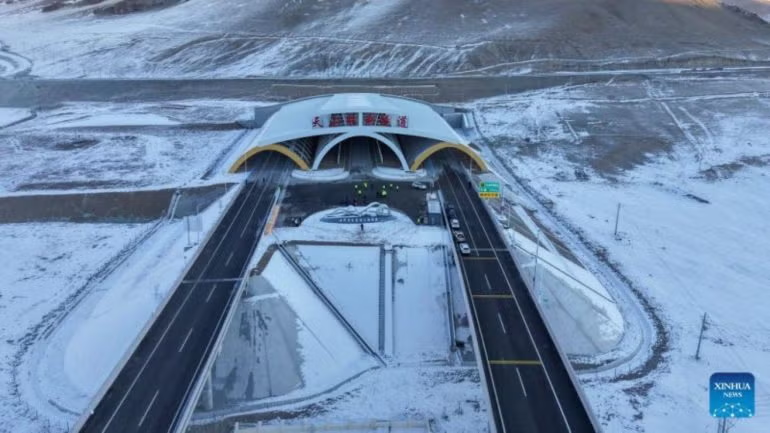
The tunnel and expressway is intended to strengthen links between urban centers in northern and southern East Turkistan. Credit: Xinhua

Chinese authorities have opened the world’s longest expressway tunnel through the Tengri Tagh (“Tianshan”) Mountains in East Turkistan, what Beijing calls “Xinjiang (New Territory),” dramatically reducing travel time between the northern and southern parts of the occupied territory while reinforcing colonial infrastructure across a heavily militarized landscape.

The China Daily reported that the 22.13-kilometer “Tianshan Shengli Tunnel” opened to traffic on December 27 as part of the Urumchi–Lopnur (“Urumchi-Yuli”) Expressway, a 324.7-kilometer route linking the colonial administrative capital with Lopnur. Officials say the tunnel cuts a journey that once took several hours over high-altitude mountain roads to about 20 minutes.

Chinese state media framed the opening as a landmark engineering achievement and a boost to regional “connectivity,” but critics note that large-scale transport infrastructure in East Turkistan has historically served Beijing’s strategic, economic, and security priorities rather than the interests of native communities.

Engineering feat through a militarized mountain range

The Tengri Tagh Mountains run more than 2,500 kilometers across central East Turkistan, dividing the country into northern and southern zones. Before the tunnel, crossings involved winding roads at elevations exceeding 4,000 metres, often closed during winter.

Construction of the expressway began in April 2020, with a reported investment of 46.7 billion yuan ($6.66bn). The tunnel itself was built at nearly 3,000 metres above sea level, in an area characterized by extreme cold, seismic risk, and complex geological fault zones.

“It was built where temperatures can drop to minus 42 degrees Celsius, with high seismic activity,” said Miao Baodong, an engineer with China Communications Construction Company, the state-owned firm responsible for the project.

The tunnel’s deepest section runs 1,112 metres beneath the mountain ridge, while its longest vertical shaft descends more than 700 metres, a configuration engineers say sets a global record.

Transport corridor tied to BRI

Chinese transport officials say the expressway connects to major national routes, including the G7 Beijing–Urumchi Expressway and the G30 corridor linking eastern China to Horgos on the Kazakh border. Together, these arteries feed into the New Eurasian Land Bridge and China’s westward trade corridors into Central Asia as part of the Belt and Road Initiative (BRI).

Li Yafei, a senior Chinese official with the colonial transport authority, said the road would “accelerate the flow of energy, manufactured goods and agricultural products” across East Turkistan and reduce logistics costs.

The expressway also links areas designated by Beijing as part of the “China (Xinjiang) Pilot Free Trade Zone,” underscoring the project’s role in facilitating state-directed trade, resource extraction, and settlement across the occupied territory.

Environmental claims and local impacts

Project engineers say sections of the expressway pass through biodiverse areas, including water-source protection zones and national forest parks, and that mitigation measures were implemented. Along a 116-kilometre stretch, 17 tunnels and 36 large bridges were constructed, accounting for nearly 60 percent of the route.

“These structures facilitate wildlife passages and provide underpasses for herders and livestock,” said Zhu Genshen, another engineer involved in the project.

In recent decades, infrastructure expansion in East Turkistan has coincided with land seizures, surveillance expansion, and the marginalization of native peoples from decision-making over development on their own land.

The expressway is set to begin trial operations on January 1, further embedding Beijing’s physical and economic control across East Turkistan through permanent transport infrastructure.

Tags: InfrastructureTransport corridors
Previous Post

CECC Report: China’s Genocide in East Turkistan Is Being Reorganized, Not Ended

Next Post

China threatens detention over Uyghur-language songs in East Turkistan, AP reports

Next Post
China threatens detention over Uyghur-language songs in East Turkistan, AP reports

China threatens detention over Uyghur-language songs in East Turkistan, AP reports

The East Turkistan Post

© 2026 East Turkistan Post

  • About Us
  • Editorial Policy
  • Editorial Position & Principles
  • Contact

Powered by
►
Necessary cookies enable essential site features like secure log-ins and consent preference adjustments. They do not store personal data.
None
►
Functional cookies support features like content sharing on social media, collecting feedback, and enabling third-party tools.
None
►
Analytical cookies track visitor interactions, providing insights on metrics like visitor count, bounce rate, and traffic sources.
None
►
Advertisement cookies deliver personalized ads based on your previous visits and analyze the effectiveness of ad campaigns.
None
►
Unclassified cookies are cookies that we are in the process of classifying, together with the providers of individual cookies.
None
Powered by
No Result
View All Result
  • English
    • ئۇيغۇرچە
    • Уйғурчә
    • Uyghurche
  • Home
  • News
    • East Turkistan
    • Exile
    • International
  • Explainer
    • In-Depth
    • Infographics
    • Profiles
  • Politics
  • Business & Economy
  • Science & Tech
  • Life
    • Community
    • Culture & Arts
    • Health
    • History
    • Religion
  • Opinion
    • Editorials
    • Guest Essays
    • Letters to the Editor

© 2026 East Turkistan Post