
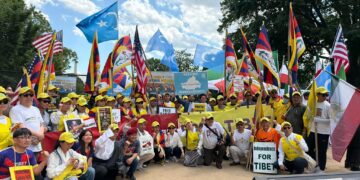
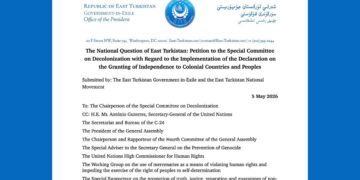



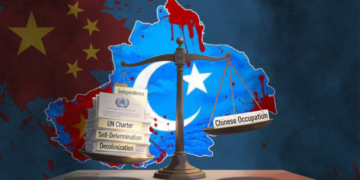




The East Turkistan Government-in-Exile (ETGE) has expressed solidarity with Somaliland following a joint diplomatic statement by China and Somalia rejecting Somaliland’s independence, saying the growing alignment reflects a broader international pattern affecting self-determination movements, including in East Turkistan, what Beijing calls “Xinjiang (New Territory),” an occupied country under Chinese rule since 1949.
The response came after a January 12 phone call between Wang Yi, China’s foreign minister, and Abdisalam Abdi Ali, Somalia’s minister of foreign affairs and international cooperation. In a joint statement issued after the call, the two governments reaffirmed what they described as mutual support on “core interests.”
“China reiterated its firm support for Somalia’s territorial integrity, stressing that Somaliland is an inalienable part of Somalia, while Somalia reaffirmed its steadfast support for the one-China principle and all of China’s efforts for national reunification, and the authority of UNGA Resolution 2758.”
— Joint China–Somalia statement, January 12
China–Somalia statement and opposition to independence
According to the statement, both sides agreed to deepen political trust and expand cooperation in trade, development assistance, people-to-people exchanges, and multilateral coordination. They also said all countries should oppose “coercive and intimidatory tactics that infringe upon the sovereignty of other countries,” phrasing China frequently uses in relation to independence and anti-colonial movements it opposes.
Somaliland has operated as a self-governing polity since 1991, following the collapse of the Somali state, and has held multiple elections while maintaining its own political and security institutions. Despite this, it remains without international recognition, aside from Israel, and its political status continues to be contested internationally.
China’s backing of Somalia’s position aligns with its broader foreign policy emphasis on territorial integrity and opposition to separatism, principles Beijing applies across disputes it considers central to its national interests.
East Turkistan government-in-exile response and criticism of OIC
In a statement issued on January 12, the East Turkistan Government in Exile said it “extends its full solidarity to the people of Somaliland,” describing Somaliland as “a Muslim-majority nation that has pursued external self-determination and established a stable, democratic society since 1991 through a legitimate process of decolonization.”
“The pursuit of independence in both East Turkistan and Somaliland represents a rightful exercise of national self-determination and decolonization, fully consistent with international law.”
— Salih Hudayar, Minister of Foreign Affairs and Security, East Turkistan Government in Exile
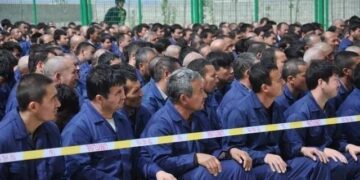
The government-in-exile said the plight of Somaliland parallels the plight of East Turkistan, condemning China for carrying out genocide and crimes against humanity against Uyghur and other Turkic Muslim peoples, including mass detention, forced labor, forced sterilization, family separation, and erasure of religious and cultural practices.
The statement also criticized the Organization of Islamic Cooperation, saying the body and several of its member states have failed to respond meaningfully to the ongoing genocide in East Turkistan. It pointed to past OIC statements that have praised China’s genocidal and colonial policies as “development” and “stability” measures.
Somalia’s shifting stance on China’s policies in East Turkistan
Somalia’s position on China’s policies in East Turkistan has varied over recent years. In 2019, Somalia joined a group of states that signed a letter to the United Nations praising China’s approach as effective in “combating terrorism and extremism” and rejecting what the letter described as “politically motivated accusations.”
In 2022, Somalia supported efforts at the UN Human Rights Council to debate the crisis in East Turkistan, a move that set it apart from most African and Muslim-majority countries and prompted warnings from Chinese officials regarding bilateral relations. Since 2023, Somalia has issued no further public criticism and has instead emphasized closer ties with Beijing.
Joint statements and diplomatic exchanges from 2024 to 2026 have reiterated mutual support on “core interests”. In 2025, Somali delegations, including representatives from the Somali National News Agency, visited East Turkistan on trips organized by Chinese authorities and publicly praised what they described as “stability,” “development,” and “counter terrorism.”

