




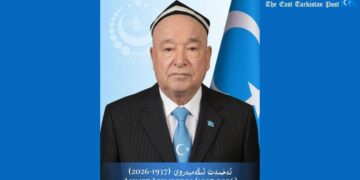




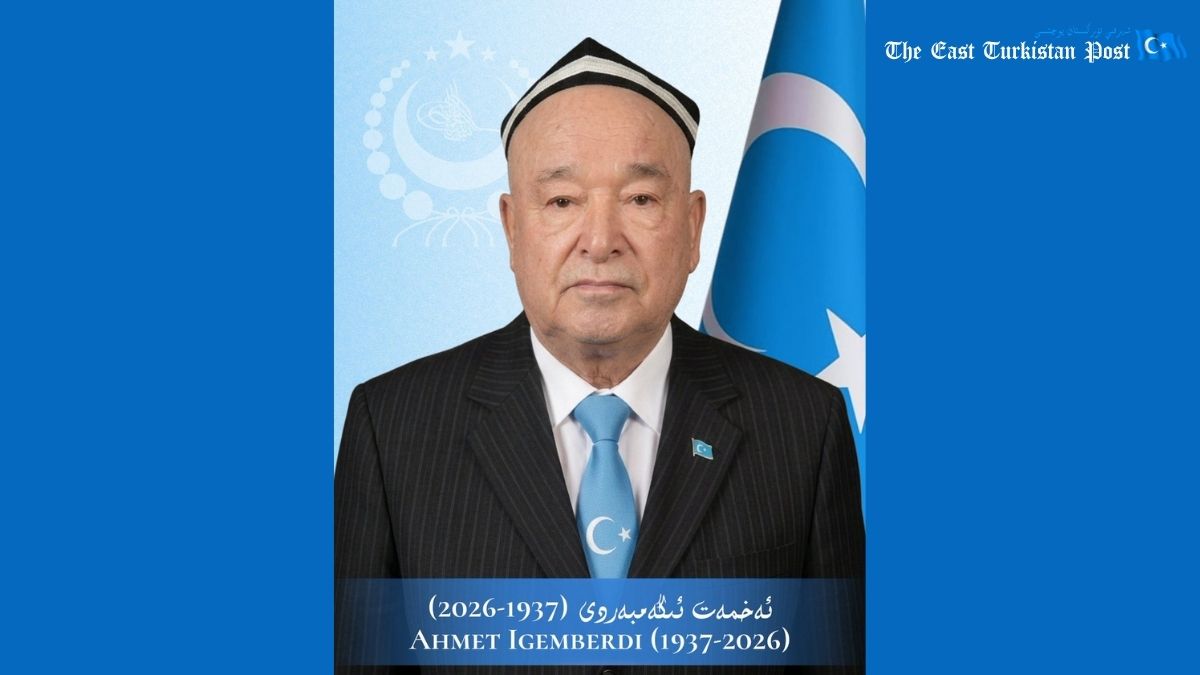
East Turkistan, what Beijing calls ‘Xinjiang (New Territory),’ has lost a prominent exile political figure. Ahmet Igemberdi, founding president of the East Turkistan Government in Exile (ETGE), died in Adelaide, Australia, on April 20, 2026, at the age of 89. The ETGE confirmed his passing in an official statement, marking the end of a decades-long role in diaspora political organisation and advocacy.
The ETGE said Igemberdi died in the early hours of Monday morning. Current ETGE President Dr. Mamtimin Ala announced the news, noting Igemberdi’s leadership and contributions to political mobilisation among East Turkistanis abroad.
Igemberdi served as the inaugural president of the ETGE following its establishment in Washington DC in 2004. He held the position until 2015. The ETGE describes him as the organisation’s longest-serving president.
Early life, imprisonment, and departure from East Turkistan
Born on April 4, 1937, in Beshbaliq, Igemberdi studied in Urumchi and later in Tashkent, Uzbekistan. He worked as a teacher and journalist and became an editor for literary publications including Tarim and Miras, which the ETGE describes as platforms for cultural expression.
In 1969, Chinese authorities charged him with being a ‘counter-revolutionary’ and ‘local nationalist,’ according to ETGE accounts. The organisation states that he was imprisoned for ten years and subjected to forced labour. Chinese government records on the case were not independently verified at the time of publication.
After his release in 1979, Igemberdi briefly returned to editorial work. He then left for Australia in 1985, where he remained for the rest of his life.
Diaspora political organisation and founding of ETGE
In Adelaide, Igemberdi founded the Australian East Turkistan Association in 1992. According to ETGE statements, the organisation focused on language education, cultural activities, and assistance for asylum seekers.
That same year, he convened the East Turkistan National Congress in Istanbul and served as its founding chairman until 1997. These efforts contributed to the formation of diaspora political structures that later expanded internationally.
His election as founding president of the ETGE in 2004 formalised political organising efforts among exile communities. Dr. Ala stated that Igemberdi consistently emphasised independence as a central objective of the organisation’s work.
Literary output and influence on later generations
Igemberdi was also known for his literary work, publishing titles in Turkish, Kazakh, Russian, and English. His writings addressed historical narratives and political perspectives concerning East Turkistan.
Among his published titles are East Turkistan: The Bleeding Wound of the Turkic World and East Turkistan and National Independence. His autobiography detailed his experiences under Chinese administration and his subsequent life in exile, according to ETGE sources.
Dr. Ala described his influence on younger activists in the ETGE statement.
‘He taught me, and a generation of East Turkistanis, that the struggle for our homeland is not a matter of convenience. It is a matter of conscience,’ Dr. Ala said.
The ETGE said Igemberdi remained active in community affairs in Adelaide, where he lived for approximately four decades.

