




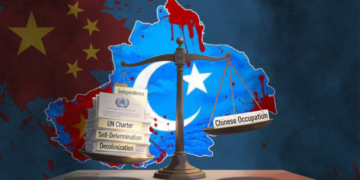


Official documents link training, placement, strict strikes, and security drills in East Turkistan.
Chinese authorities expand training and security measures in East Turkistan
Summary: Official documents tie training, placement, and security drills to stability policy.
By The East Turkistan Post Staff | March 17, 2026
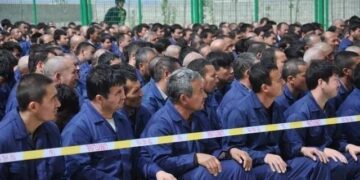
East Turkistan, what Beijing calls ‘Xinjiang (New Territory),’ has seen Chinese authorities expand programmes described as “training” (培训), “placement” (安置), and “strict legal strikes” (依法严打) as part of a broader stability campaign, according to official Chinese documents from 2024 to 2026. The developments matter because they combine social management, employment policy, and armed security activity in a way that raises questions under international human rights standards.
The reviewed materials come from the Chinese Ministry of Justice and provincial-level government outlets. Chinese officials present the measures as lawful responses to “extremist thoughts,” separatism, and terrorism, while the documents provide limited detail on oversight, consent, or independent review.
Training and placement policies
An MOJ document on East Turkistan’s legal and stability work says authorities should deepen “de-extremification” and “educate and save” people influenced by extremist thoughts, while also securing “ideological stability” and livelihoods. The same text links these efforts to “stabilising the borders” and strengthening what officials describe as long-term security management.
Later statements from senior Chinese security and legal officials repeat similar language. A 2024 report said officials should “firmly hold social stability as the foremost task” and improve work related to employment, family stability, and public order. In those materials, “placement” appears alongside job schemes and social management for people identified by officials as vulnerable to instability.
The public record reviewed here does not explain how participation is determined or what safeguards exist against coercion. International legal standards, including protections against forced labour and arbitrary detention, require that such programmes be voluntary, necessary, and independently reviewable.
Strict-strike language
The same official documents repeatedly call for “precise legal strikes” and an “unshakable high-pressure strict-strike posture” against violent terrorism, separatism, and religious extremism. Chinese officials describe these measures as lawful and necessary for public order, but the available texts do not provide information on trial standards, appeal rights, or external monitoring.
One MOJ article says authorities should “maintain the high-pressure strict-strike posture without wavering.” That language is significant because it presents punitive action not as a temporary campaign, but as a continuing governance method tied to stability management.
Security drills and military display
At the same time, Xinjiang authorities have staged large armed exercises under the title “Anti-Terror Deterrence-2025.” A provincial report said one drill involved 4,000 personnel from military, armed police, border inspection, public security, and production-construction units.
The official descriptions said the exercises included scenarios such as joint border interception, preventing infiltration, urban encirclement, and blocking illegal crossings. A separate 2025 report said the purpose was to improve command capacity and demonstrate determination to combat violent terrorism. Chinese state media present these drills as routine security preparation.
International humanitarian law restricts the use of military force in ways that may affect civilians, and human rights bodies have called for independent access to East Turkistan to assess conditions directly. Such access remains limited, leaving outside analysis dependent on official texts, satellite evidence, and secondary reporting.
Human rights questions
Taken together, the documents suggest a policy framework in which training, placement, legal punishment, and armed drills are linked under one stability agenda. That structure is notable because it blends social policy with security enforcement and uses highly coercive language to describe ordinary governance tasks.
China rejects criticism of its East Turkistan policies and says it is combating terrorism and promoting development. The available official documents, however, do not address the safeguards that international law expects when states combine employment policy, ideological work, and security operations in the same administrative system.
The East Turkistan Post is an independent news publication. All claims are attributed to their respective sources. Access restrictions inside East Turkistan limit independent on-the-ground verification.
