




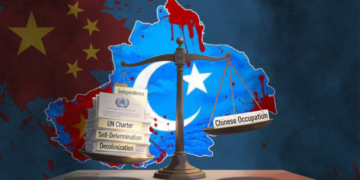



Summary: Archives trace Turkic governance structures and two formal independence declarations in East Turkistan.
By The East Turkistan Post Staff | April 5, 2026
WASHINGTON — East Turkistan, what Beijing calls ‘Xinjiang (New Territory),’ has a recorded history of independent statehood through successive Turkic polities and two formal republics established in the 20th century, according to historical documentation and archival sources.
The historical record draws from Soviet, Chinese Nationalist, and exile government archives. It traces governance structures that predate Chinese administrative contact. Furthermore, it extends through two short-lived republican governments, each dissolved under external military pressure.
Turkic states governed territory before Chinese contact
Historical records identify East Turkistan as the centre of independent Turkic states. These include the Xiongnu Empire, the Kushan Empire, the Turkic Khaganate, the Uyghur Khaganate, the Kara-Khanid State, and the Yarkent Khanate. Documentation places the emergence of a Uyghur political confederation in the 6th century. Archival sources record a Turkic presence in Central Asia spanning several millennia.
Archival sources note that the Great Wall historically marked the boundary of Chinese-administered territory. Lands beyond it were governed separately under Turkic political structures. Historical accounts describe a distinct language, culture, and political organisation differentiating East Turkistan from Chinese-administered territories.
The Manchu Qing Dynasty invaded East Turkistan in 1759, according to historical records. More than a century of documented resistance followed. Available records list 42 recorded uprisings between 1759 and 1863.
In 1865, leader Yaqub Beg established the State of East Turkistan, also referred to in some sources as Kashgaria. It maintained independence until a Qing military campaign in 1877. Qing authorities then formally incorporated the territory as Xinjiang Province in 1884. Historians cite the designation ‘Xinjiang,’ translated as ‘New Territory,’ as an acknowledgement of the territory’s previously separate administrative status.
Two formal republics declared in the 20th century
Following the collapse of Manchu rule in 1911, Turkic leaders declared the First East Turkistan Republic on November 12, 1933, centred in Kashgar. State records indicate the republic established a constitution, a standing military, and an independent currency.
‘On November 12, 1933, over 20,000 people gathered to formally proclaim independence as the Islamic Republic of East Turkistan,’ according to historical documentation cited in archival sources.
The republic operated for approximately six months. Chinese Nationalist forces, with Soviet assistance, overthrew it on April 16, 1934. Records identify Sabit Damolla Abdulbaqi as Prime Minister, serving under President Khoja Niyaz.
A second declaration followed a decade later. The Second East Turkistan Republic declared independence on November 12, 1944, with its administrative centre in Ghulja, also known as Yining. Documentation records that the republic’s National Army expanded to approximately 40,000 troops. The East Turkistan National Liberation Organisation elected Alihan Tore as president, with Abdulkerim Abbasov serving as internal affairs minister.
1949 incorporation ended second republic’s operations
The second republic’s existence ended under documented circumstances. Senior leadership, including the president, foreign minister, and military commanders, departed for Moscow on August 24, 1949. Soviet archival records report the aircraft crashed near Irkutsk, killing all 14 senior officials aboard.
By December 22, 1949, East Turkistan National Army units had been incorporated into China’s People’s Liberation Army. Demographic records from 1949 document the territory’s population as exceeding 90 percent Turkic peoples, with the Chinese population recorded at below 5 percent.
Declassified Soviet archival records indicate that Joseph Stalin advised Mao Zedong in 1949 to implement state-sponsored settlement policies. These aimed to increase the Chinese population in East Turkistan from under 5 percent toward a 30 percent target. Historical accounts state that initial Chinese Communist Party commitments to self-determination were not implemented following incorporation.
Chinese government position and archival access limits
The Chinese government maintains in official documentation that it has administered East Turkistan continuously since the 1884 Qing Dynasty incorporation. Authorities describe the Xinjiang Uyghur Autonomous Region as integral Chinese territory. They characterise governance since 1949 as serving security and development objectives. Official Chinese records present the 1949 incorporation as legitimate internal consolidation rather than annexation of a separately functioning sovereign entity.
Independent researchers report that access restrictions inside East Turkistan limit comprehensive verification of pre-1949 governance documentation. Soviet, Chinese government, and exile government archives remain the primary sources available for historical analysis.
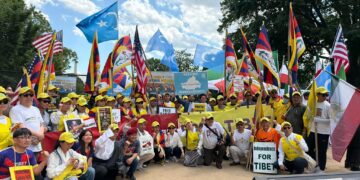
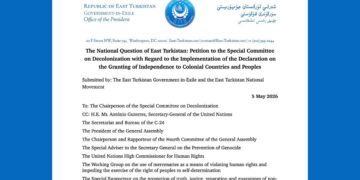
The East Turkistan Government in Exile, based in Washington DC, states in its published policy positions that current administrative arrangements continue patterns established following what it characterises as the 1949 annexation of a functioning state with documented sovereign capacity.
The East Turkistan Post is an independent news publication. All claims are attributed to their respective sources. Access restrictions inside East Turkistan limit independent on-the-ground verification.
