





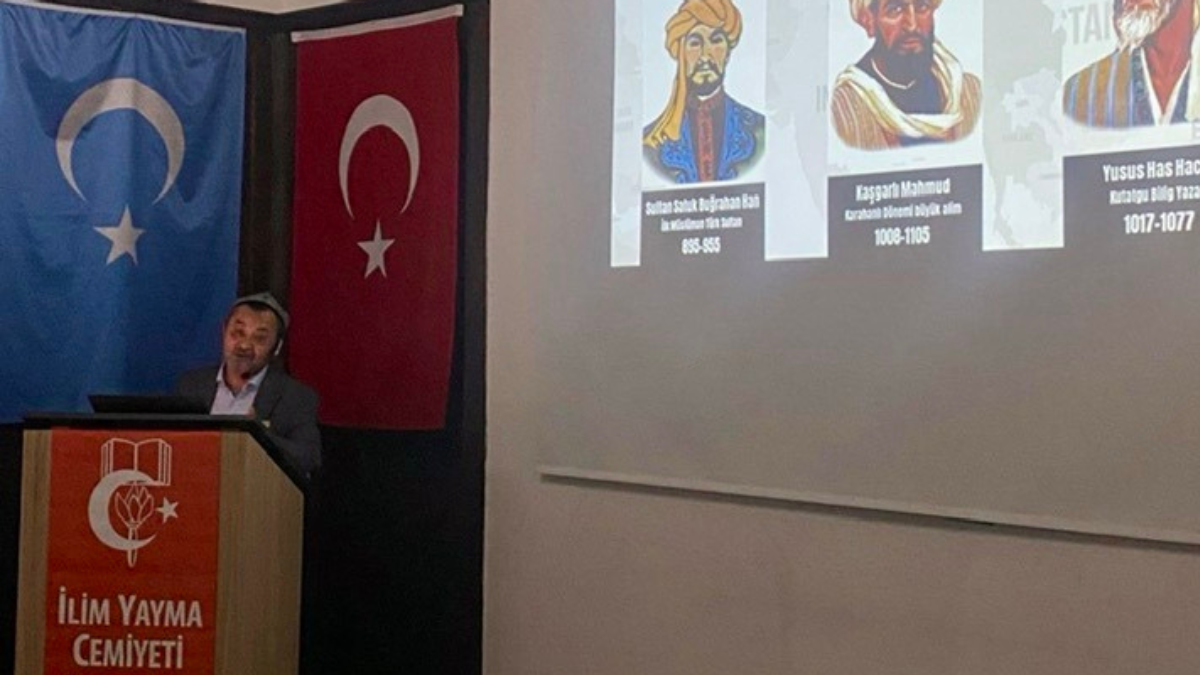
East Turkistan, what Beijing calls “Xinjiang (New Territory),” was the focus of a civil society gathering in the western Turkish city of Kütahya on February 7, 2026, as organisers framed the issue as a moral and political test for Ankara’s China policy. The programme was hosted by the Kütahya branch of the Ilim Yayma Cemiyeti [Knowledge Dissemination Society] at the Hocazade Nuri Bilge Mansion and held under the title “Medeniyetimizin Şah Damarı Doğu Türkistan: Köklerimizden Yükselen Feryat” [“East Turkistan, the jugular vein of our civilisation: a cry rising from our roots”].
Organisers’ posts described the event as part of a wider “civilizational vigil” theme, with Uyghur journalist-writer Mirkamil Kaşgarlı addressing attendees. İsmail Çağlar Bayırcı, an AK Party deputy from Kütahya, attended the event alongside other local figures—an appearance organisers portrayed as a sign the issue is moving beyond diaspora circles and into broader civic politics.
Organisers call for a firmer state position
In public messaging around the gathering, organisers and sympathetic pages urged Ankara to take a clearer stance internationally, including calling for formal genocide recognition and stronger diplomatic action.
“Until East Turkistan is free, Anatolia’s civilizational vigil will continue without interruption.”
— Ilim Yayma Cemiyeti Kütahya branch
Speakers and organisers framed East Turkistan as a central concern for Turkiye’s wider Turkic and Muslim public, arguing that humanitarian hosting policies for diaspora communities are not sufficient without sustained diplomatic pressure.
Ankara’s cautious language remains unchanged
Turkiye’s government has periodically voiced concern about human rights conditions affecting Uyghurs and other communities, but it has not formally recognised genocide. In a September 8, 2022 statement responding to the United Nations human rights office report, Turkiye’s foreign ministry said the findings “confirm the concerns” in domestic and international public opinion and called for the report’s evaluations to be taken into account.
That official caution has persisted alongside Turkiye’s economic and political engagement with China, a dynamic repeatedly cited by activists as a reason public pressure continues to build in municipalities and civic venues such as Kütahya.
The Kütahya programme reflects a broader pattern in Turkiye, where civil society groups, faith-linked associations, and community organisers increasingly stage public events demanding a sharper policy line on East Turkistan, as allegations of genocide and crimes against humanity remain central to international debate on accountability.

