











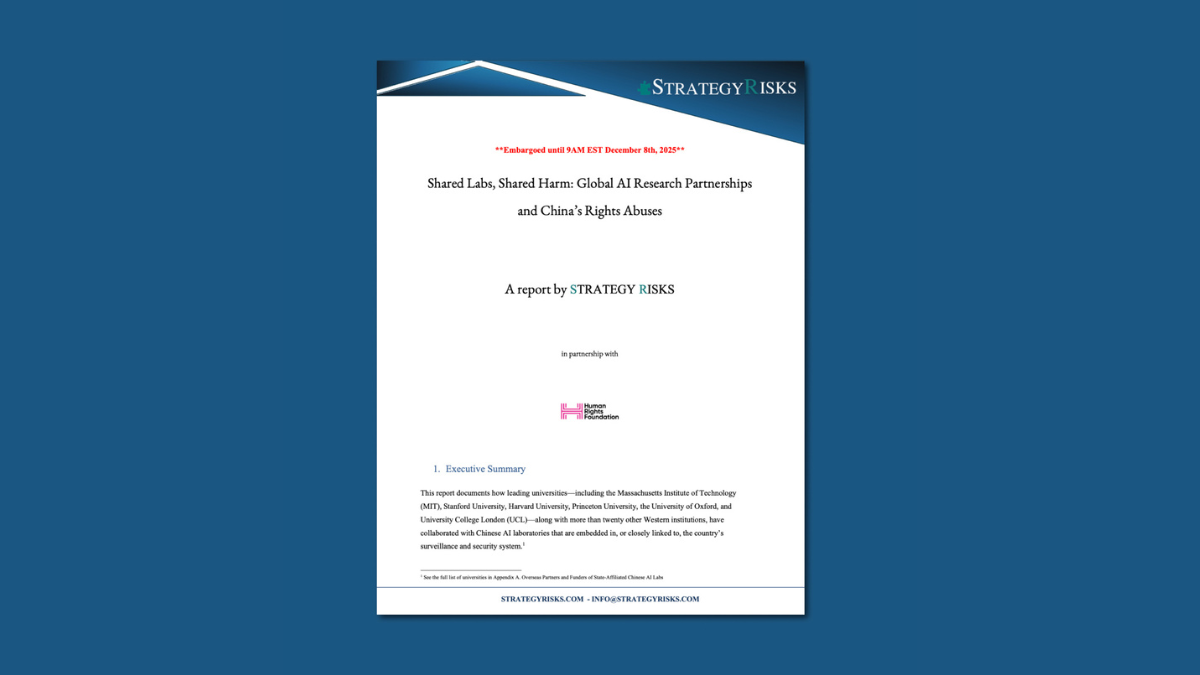
A new report has found that several elite United States universities have collaborated extensively with Chinese state-linked artificial intelligence laboratories whose research supports mass surveillance and repression in East Turkistan, what Beijing calls “Xinjiang (New Territory),” raising concerns about academic complicity in the ongoing Uyghur genocide.
The findings were first reported by Fox News and are based on a report released on December 8 by Strategy Risks and the Human Rights Foundation, documents thousands of co-authored academic papers between Western researchers and two major Chinese institutions: Zhejiang Lab and the Shanghai Artificial Intelligence Research Institute. Both laboratories maintain formal ties to China’s security and defense apparatus.
According to the report, researchers affiliated with universities including MIT, Harvard University, Stanford University, and Princeton University have co-authored approximately 3,000 papers with the two Chinese labs since 2020.
Research tied to surveillance infrastructure
The report states that both Zhejiang Lab and the Shanghai Artificial Intelligence Research Institute collaborate closely with the China Electronics Technology Group Corporation, a state-owned defense conglomerate that has played a central role in building surveillance platforms deployed by Chinese authorities in East Turkistan.
These platforms integrate technologies such as facial recognition, gait analysis, multi-object tracking, and infrared detection—tools that researchers and journalists have repeatedly documented as being used to monitor, profile, and detain Uyghurs and other Turkic peoples.
“With Western support and U.S. government funding, the labs have developed technologies in multi-object tracking, gait recognition, and infrared detection.”— Strategy Risks
Chinese authorities claim that large-scale repression in East Turkistan has ended and that life in the territory has returned to normal. Beijing frames its policies as lawful security and counterterrorism measures and rejects allegations of genocide or crimes against humanity.
The report counters that these claims conflict with extensive documentation accumulated over the past decade showing that digital surveillance systems remain central to its colonial governance in East Turkistan. Independent reporting inside the territory remains severely restricted due to pervasive monitoring, censorship, and the risk of detention, making external investigations rare.
Legal obligations under Chinese law
The authors stress that the issue is not covert espionage but the normalization of academic collaboration with institutions that are legally obligated to support China’s security and intelligence apparatus.
Under China’s national security, intelligence, cybersecurity, and data security laws, all research organizations are required to cooperate with state authorities and provide access to data and technological developments upon request. As a result, the report argues, Western academic research can be absorbed directly into systems that facilitate mass repression and the continuation of genocidal policies.
“Inside China, no research entity is independent of the Chinese Communist Party.”
— Alex Gladstein, Chief Strategy Officer of the Human Rights Foundation
The report calls for mandatory human rights due diligence for international research partnerships, greater transparency around foreign co-authorships, and limits on collaboration with Chinese state-linked laboratories involved in surveillance and defense research.

