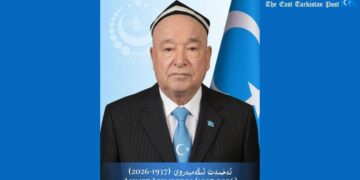
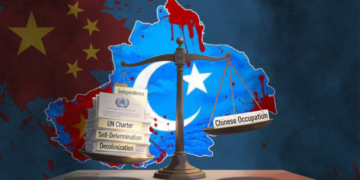
The prime minister of the East Turkistan Government-in-Exile issued a New Year’s address on Wednesday, marking the start of 2026 with renewed calls for international action on what he described as ongoing genocide, crimes against humanity, and colonial occupation in East Turkistan, what Beijing calls “Xinjiang (New Territory),” urging the United Nations and governments worldwide to move beyond recognition toward concrete accountability.
In a statement published by the Government-in-Exile, Prime Minister Abdulahat Nur said the new year marked 76 years since the Chinese state established control over East Turkistan and nearly 12 years since what he described as the onset of genocide in May 2014. He framed the anniversary as a test of the credibility of the international system, arguing that extensive documentation and acknowledgments had failed to protect the territory’s native peoples.
“The people of East Turkistan are not facing isolated or incidental human rights violations. We are confronting the systematic execution of a colonial project designed to erase a nation.” — Abdulahat Nur, prime minister of the East Turkistan Government in Exile
⚖️New Year’s Message of the Prime Minister of the East Turkistan Government in Exile
As the world enters the year 2026, I address the people of East Turkistan and the international community on behalf of the East Turkistan Government in Exile. This message is issued as our… pic.twitter.com/36QqdIA4h0
— East Turkistan Government in Exile (ETGE) (@ETExileGov) January 1, 2026
Address to the United Nations and accountability mechanisms
A central focus of the address was a direct appeal to the United Nations, which Nur said has possessed “credible and overwhelming evidence” of genocide and crimes against humanity for more than a decade. He argued that the gap between acknowledgment and enforcement had allowed abuses to continue and had undermined the integrity of international law.
“For more than a decade, the United Nations has possessed credible and overwhelming evidence of genocide and crimes against humanity in East Turkistan. Yet recognition has not been matched by protection, and documentation has not led to deterrence.” — Abdulahat Nur, prime minister of the East Turkistan Government in Exile
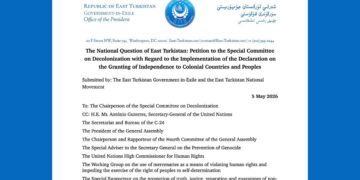
Nur called on UN bodies, including the General Assembly and Human Rights Council, to formally address what he described as the national question of East Turkistan and the right of its people to decolonization and self-determination. He also urged states to support accountability efforts through international judicial mechanisms, including cases related to East Turkistan submitted to international courts.
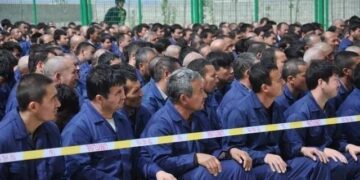
The statement asserted that treating the situation solely as a human rights issue, rather than one of occupation and colonial domination, had failed to halt what Nur characterized as mass detention, forced assimilation, demographic engineering, and pervasive surveillance.
Appeals to Muslim, Turkic, and Western governments
The New Year message also addressed specific international groupings, including Muslim-majority states, Turkic states, and Western democracies. Nur urged Muslim governments and institutions such as the Organization of Islamic Cooperation to publicly confront what he described as one of the most severe campaigns against a Muslim people in modern history, warning that silence or political accommodation amounted to moral failure.
Turning to Turkic states, Nur said shared language, history, and origin carried concrete responsibilities, calling on the Turkic States Organization to address the situation in East Turkistan substantively rather than symbolically. He also criticized Western governments for what he described as reliance on statements and resolutions without addressing what he identified as the root cause: ongoing occupation.
“There is no sustainable path to protecting the freedoms, human rights, or survival of our people without decolonization and the restoration of East Turkistan’s independence.” — Abdulahat Nur, prime minister of the East Turkistan Government in Exile
The statement concluded with a warning that practices developed in East Turkistan, including mass surveillance and repression, were increasingly exported beyond its borders, posing broader risks to international norms. Nur said history would judge not expressions of concern, but whether governments acted while the crimes were known and ongoing.
The full New Year’s address was published by the East Turkistan Government in Exile on its official platforms.