




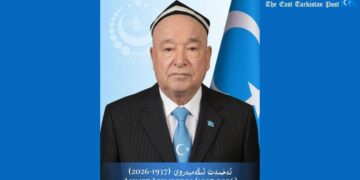


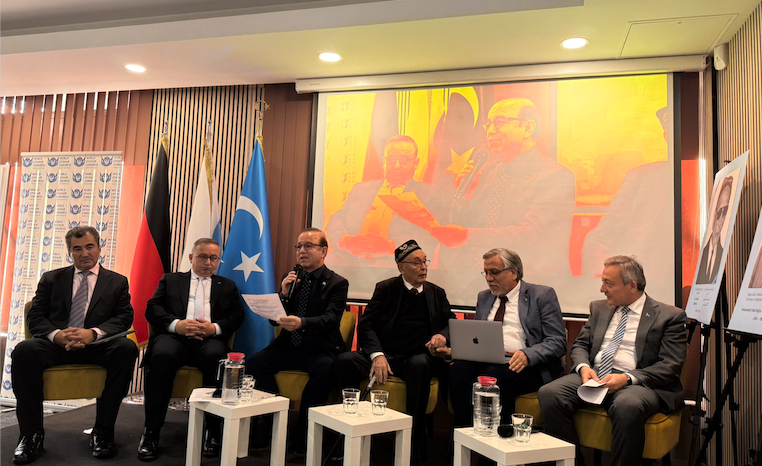
The World Uyghur Congress (WUC) marked the 30th anniversary of the passing of Isa Yusuf Alptekin on December 20 with a series of commemorative events held in Munich, Germany. The organization described the program as honoring “the legacy of East Turkistan’s statesmen and leaders who dedicated their lives to independence, dignity, and justice.”
According to the WUC, the program began with an evening exhibition and continued the following day with a conference focused on the legacy of East Turkistan’s political leaders and the historical struggle for Uyghur rights.
The conference, titled “Isa Yusuf Alptekin on the 30th Anniversary of His Death: Commemoration of East Turkistan State Leaders,” was opened by Turgunjan Alawdun, president of the World Uyghur Congress, and moderated by WUC Vice President Abdulreshit Abdulhamit. The events brought together Uyghur rights activists, Turkish parliamentarians, and political figures whom the organization described as having been vocal in defending what it termed the Uyghur cause.
ETGE Rejects Characterization
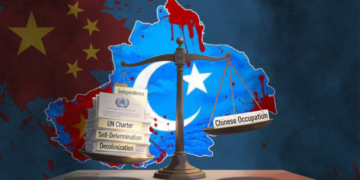
The commemoration prompted a sharp response from the East Turkistan Government-in-Exile (ETGE), which rejected the portrayal of Alptekin and related figures as leaders of East Turkistan’s independence movement.
The characterization of Isa Yusuf Alptekin as an independence leader is disputed by the East Turkistan Government-in-Exile, which says historical records and academic research show that he opposed both East Turkistan republics (1933-1934 and 1944-1949) and promoted autonomy under Chinese rule.
In a public statement, the ETGE said attempts to elevate Alptekin and associated figures as “independence leaders” constitute deliberate historical falsification aimed at undermining East Turkistan’s national liberation struggle.
Objection to the Labeling of “Three Effendis” as “East Turkistan State Leaders”
The ETGE said its objection centered in part on the conference’s framing of Alptekin and the “Three Effendis [Three Gentleman],” a grouping that includes Alptekin, Mehmet Emin Bughra, and Mesut Sabri, as “East Turkistan State leaders.”
The exiled government said describing them as “East Turkistan State leaders” is historically false and contradicts the record. It argued that the “Three Effendis” opposed the East Turkistan Republic and were aligned with and served the Chinese Nationalist (Kuomintang) regime in efforts to dismantle the independent East Turkistan state that emerged on November 12, 1944, in Ghulja.
According to the ETGE, contemporaneous records from the East Turkistan Republic itself reflect this view. The exiled government pointed to documents from the period, including a 1946 pamphlet issued by the East Turkistan Republic and translated and archived by the U.S. Department of State, in which collaborators aligned with Chinese rule were explicitly described as “spies,” “traitors,” and “puppets.”
The ETGE said that elevating Isa Yusuf Alptekin and the “Three Effendis” as national leaders obscures the historical distinction between movements that sought full independence and political engagement conducted within Chinese state structures.
According to the exiled government, framing autonomy and human rights under Chinese rule as resistance serves to recast collaboration as national struggle and, in its view, risks prolonging China’s occupation and colonial domination of East Turkistan.
Academic Record and Historical Context
Academic scholarship has examined this political divide in detail. In a 1991 study published by the Society for Central Asian Studies, historian Linda Benson examined Isa Yusuf Alptekin alongside Mesut Sabri and Mehmet Emin Bughra as the three most prominent Uyghur political figures who served the Chinese Nationalist regime.
Benson wrote that contemporary and later sources often portrayed the three men as closely aligned with China’s Nationalist government and personally loyal to Chiang Kai-shek. According to her research, they were widely viewed as figures sent to East Turkistan to help integrate the region into the Chinese state and prevent efforts to separate East Turkistan from China, functioning as local political figureheads within a Chinese-dominated system.
ETGE officials say this scholarly record reinforces their rejection of Alptekin and the “Three Effendis’s portrayal as East Turkistan’s state leaders or independence leaders.
Competing Political Paths
The dispute also reflects fundamentally different political projects among exile organizations.
The World Uyghur Congress, based in Munich, Germany, was founded in April 2004 under the leadership of Erkin Alptekin, the son of Isa Yusuf Alptekin. The organization has primarily focused on international advocacy related to Uyghur human rights.
The WUC has consistently framed its advocacy around human rights protections and calls for what it describes as “genuine autonomy,” arguing that expanded cultural and religious freedoms would reduce repression and conflict.
The East Turkistan Government-in-Exile, based in Washington, D.C., was established in September 2004 as a government-in-exile advocating for the restoration of East Turkistan as an independent country representing all of its native peoples.
The ETGE rejects autonomy-based frameworks, arguing that they have historically functioned to delay independence while allowing occupation and repression to deepen.
Independence as the Central Question
The exchange underscores a long-running divide within exile organizations over the political future of East Turkistan: whether liberation lies in full decolonization and independence or in negotiated arrangements under Chinese sovereignty.
The ETGE reiterated that it considers independence non-negotiable.
“Our nation’s future rests with those who demand nothing less than the complete restoration of East Turkistan’s independence and sovereignty.”
— East Turkistan Government-in-Exile
At the time of publication, the World Uyghur Congress had not responded to the ETGE statement beyond its original announcement describing the commemorative events.

