




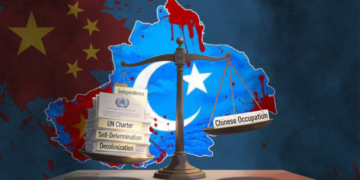


East Turkistan detention camps are being replaced by prisons while forced labour transfers expand across China.
By The East Turkistan Post |
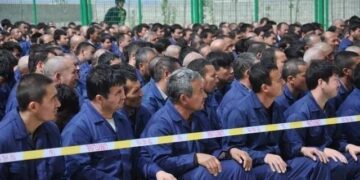
WASHINGTON — East Turkistan, what Beijing calls ‘Xinjiang (New Territory),’ is the site of a restructured East Turkistan detention system that observers describe as a more formalised phase of repression. The East Turkistan Government in Exile (ETGE) says China has moved from extrajudicial vocational training centres to high-security prisons and state-mandated labour transfers. The group argues this shift institutionalises detention and makes the erasure of Turkic identity more permanent. Furthermore, the ETGE states that only East Turkistan independence can fundamentally end the system.
The ETGE says former detainees are being moved into the formal prison system and that long-term judicial sentencing is now common. These claims are presented as ETGE assertions and have not been independently verified by The East Turkistan Post.
East Turkistan detention transitions from camps to judicial system
The ETGE cites a Financial Times exposé and related documentation. It says these confirm that former camp detainees are being transferred into high-security facilities. According to the group, people now face long-term sentences through the judicial system after previously being held in extrajudicial centres.
Human Rights Watch is cited by the ETGE as reporting that approximately half a million people have been prosecuted through the formal system since 2017. The ETGE also highlights testimony from Zhang Yabo, a former Chinese police officer who served in Khotan from 2014 to 2023. The group says Zhang’s account supports the claim that detainees are transferred into prisons and that torture is used during interrogations.
The ETGE argues that by moving internment into the judicial sphere, Beijing is attempting to give legal cover to policies that the United States and several Western parliaments have described as genocide. Chinese authorities reject those descriptions. They say their policies are lawful measures aimed at stability and development, according to official statements.
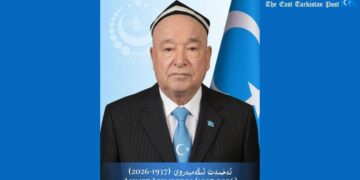
‘Beijing did not dismantle its genocide. It professionalized it,’ said Dr. Mamtimin Ala, ETGE President, in a statement. ‘Twelve years of documented atrocities and twelve years of international inaction have brought our people to the edge of erasure.’
For background, see our earlier report on the ETGE’s rejection of the mass detention pretext.
East Turkistan detention linked to expanding forced labour transfers
At the same time, the ETGE says poverty alleviation through labour transfer programmes have intensified. The group describes these as forms of state-sponsored mass slavery.
UN Special Rapporteurs warned in January 2026 that the coercive elements of these transfers may amount to enslavement as a crime against humanity, according to the ETGE. In addition, the group says China’s own five-year plan for East Turkistan projected 13.75 million forced labour transfers between 2021 and 2025. The East Turkistan Post could not independently verify these figures or the ETGE’s interpretation of the UN warnings.
The ETGE says these programmes forcibly relocate Uyghur, Kazakh, and Kyrgyz individuals hundreds of kilometres from their homes, often to other provinces. Workers face continuous monitoring at their destinations, according to the group. Moreover, the ETGE argues the transfers are designed to obscure forced labour-linked supply chains in global markets, including textiles, agriculture, and high-tech manufacturing.
See also our report on the ETGE’s condemnation of the Trans-Altai trade forum.
ETGE links East Turkistan detention to colonial occupation and calls for independence
The ETGE points to China’s March 2026 Law on Promoting Ethnic Unity and Progress as a legislative step to codify identity erasure. It says the law criminalises assertions of distinct Turkic identity and reinforces colonial domination through statute.
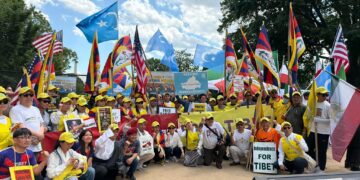
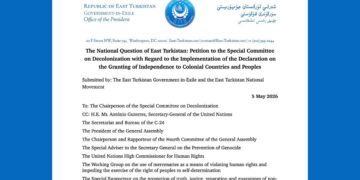
Salih Hudayar, ETGE Minister of Foreign Affairs and Security, said addressing East Turkistan detention alone is insufficient. He stated that the root cause — the 1949 invasion and subsequent occupation — must be addressed. Consequently, the ETGE is pressing the UN Special Committee on Decolonization to recognise East Turkistan as a Non-Self-Governing Territory. It is also pursuing its complaint before the International Criminal Court.
The ETGE argues that East Turkistan independence is the only guarantee of the native population’s survival. Chinese officials have not responded directly to the specific claims in this report.
The East Turkistan Post is an independent news publication. All claims are attributed to the ETGE, cited reporting, or named individuals. Figures on forced labour, prison prosecutions, and other assertions from the ETGE have not been independently verified. Access restrictions inside East Turkistan limit on-the-ground confirmation.
