




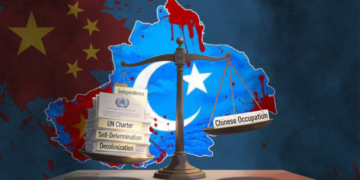


Advocacy groups asked US lawmakers to recognise occupied status and support East Turkistan independence.
By The East Turkistan Post | May 15, 2026
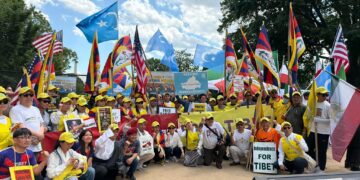
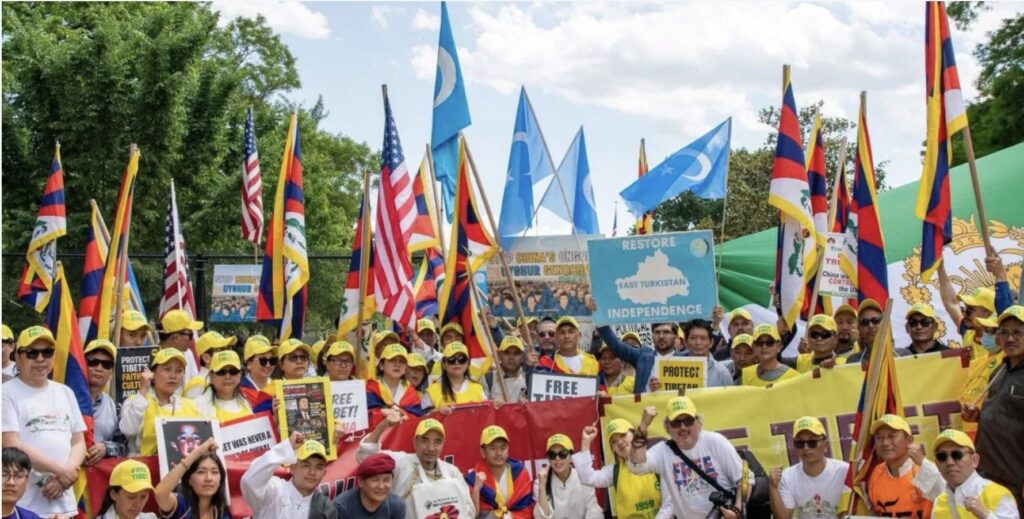
WASHINGTON — East Turkistan, what Beijing calls ‘Xinjiang (New Territory),’ was the focus of a joint advocacy effort in Washington DC on May 15, 2026. Representatives from East Turkistan and Tibetan groups met US lawmakers to seek formal support for East Turkistan independence. The delegations framed their campaigns as efforts to win legislative recognition of occupied status and press for new US policy measures.
The delegation included representatives from the East Turkistan Government in Exile (ETGE), the East Turkistan National Movement (ETNM), the East Turkistan National Fund, and Tibetan Patriots for Independence. According to the groups, they met staff from six senators and more than 20 House members. They concluded with a joint appeal at the Dirksen Senate Office Building.
East Turkistan independence requests put to Congress
The East Turkistan delegation asked Congress to pass a resolution recognising East Turkistan as an occupied country. They sought recognition similar to existing US policy on Tibet. In addition, the group called for a Special Coordinator for East Turkistani Issues at the State Department. Furthermore, it asked for the current Uyghur Policy Act to be renamed the East Turkistan Policy Act.
‘You cannot stop a genocide while preserving the occupation that created it,’ said Salih Hudayar, ETGE Foreign Minister, in a statement. ‘Independence is not a radical demand; it is the only way to guarantee the human rights and survival of our people.’
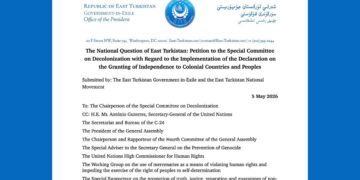
The ETGE also urged lawmakers to support its petition to the UN Special Committee on Decolonization and its complaint to the International Criminal Court. The organisation said those legal efforts challenge Chinese administration of East Turkistan through international institutions.
For background, see our earlier report on the ETGE’s UN decolonization petition.
ETGE describes Chinese rule as occupation and assimilation policy
The ETGE told lawmakers that Beijing’s March 2026 Law on Promoting Ethnic Unity and Progress is part of a wider assimilation policy. The group argued the law criminalises expressions of distinct identity and reinforces Chinese control over East Turkistan.
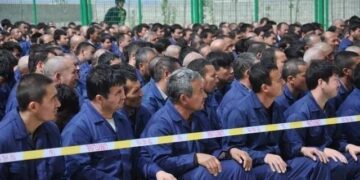
The delegation described Chinese administration as the result of what it calls the 1949 invasion and occupation of East Turkistan. It also stated the territory has entered its thirteenth year of genocide. This claim is presented here as the ETGE’s position and remains disputed. It has not been independently verified by The East Turkistan Post.
The ETGE and ETNM argue that East Turkistan met statehood criteria under the 1933 Montevideo Convention before 1949. They further state that no treaty of cession or plebiscite legitimised Chinese rule. These legal arguments are being advanced in Washington and at the United Nations.
See also our report on ETGE’s appeal to President Trump ahead of the Beijing summit.
Tibetan delegation links campaign to broader sovereignty push
Tibetan representatives, led by Tenzin Wangdu, made a separate appeal to Congress. They asked for recognition of February 13 as Tibet Independence Day. Moreover, they called for stronger US opposition to Beijing’s assimilation policies in Tibet.
Wangdu said Tibet was historically sovereign before the 1951 Chinese takeover, citing its own government, currency, and national identity. These claims formed part of the delegation’s presentation to lawmakers and were not independently verified by The East Turkistan Post.
Both delegations linked their campaigns to the 1959 Captive Nations Law. They argued the United States should support peoples they say are under communist rule. Together, they described their efforts as part of a larger push for national sovereignty and international recognition.
Chinese officials consistently reject allegations of systemic abuses and describe policies in East Turkistan as lawful measures to promote unity, stability, and development, according to Chinese state media. No official Chinese response to the May 15 advocacy meetings was available at the time of publication.
The East Turkistan Post is an independent news publication. All claims are attributed to the organisations and individuals cited. ETGE, ETNM, and Tibetan delegation assertions are reported as the groups’ positions. Access restrictions inside East Turkistan limit independent on-the-ground verification.
