




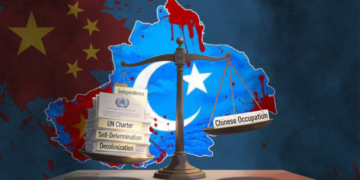


East Turkistan, what Beijing calls ‘Xinjiang (New Territory),’ faces renewed scrutiny over press freedom ahead of World Press Freedom Day on May 3. Reports from exile organisations and international monitors describe a structured information environment blocking independent journalism. The East Turkistan Government in Exile (ETGE) states that without restoring East Turkistan’s sovereignty and independence, the information blockade — like every other dimension of the crisis — cannot be fundamentally resolved.
The ETGE characterised the situation as a deliberate blockade serving the interests of continued occupation. According to the group, restrictions prevent unmediated accounts from residents and shield Chinese administration from independent scrutiny
Information controls serve occupation, ETGE states
Foreign journalists attempting to report from East Turkistan face continuous surveillance and enforced government escorts, according to reports reviewed by The East Turkistan Post. International media outlets have documented physical interference preventing direct contact with native residents.
Residents who attempt to contact international media face interrogation and reprisals affecting family members, according to exile accounts. Independent researchers face parallel barriers. As a result, much verifiable data has come from satellite imagery. The Australian Strategic Policy Institute has mapped detention sites using this method, without the possibility of on-site confirmation.
‘The state-imposed information blackout in East Turkistan is not merely about stopping news; it is a fundamental component of the colonization process, intended to hide the scale of the ongoing genocide from the global community,’ the ETGE said in an official statement.
Chinese authorities state that media policies in East Turkistan comply with domestic law. Officials frame access restrictions as measures against what they describe as misinformation.
Detention and demographic data blocked from verification
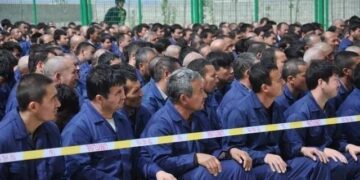
The ETGE estimates that between one million and three million people have passed through detention facilities in East Turkistan since 2014. The group cites researchers and data points from a 2020 Chinese government White Paper in support of this range. The East Turkistan Post could not independently verify these figures due to the absence of transparent access to the territory.
Amnesty International and United Nations bodies have noted significant birth rate declines in parts of East Turkistan since 2016. Independent observers have linked these declines to coercive population control measures. Chinese officials describe family planning in East Turkistan as voluntary and nationally uniform.
The ETGE states that these policies form part of a systematic campaign against the native Turkic population. The group argues that genocide recognition and human rights resolutions, while significant, address symptoms rather than the root cause. In the ETGE’s stated position, only the restoration of East Turkistan’s sovereignty and independence can fundamentally resolve the conditions that the information blockade is designed to conceal.
Resolutions and legal action fall short of sovereignty restoration
The United States, Canada, the United Kingdom, the Netherlands, Lithuania, and the Czech Republic have issued formal resolutions describing conditions in East Turkistan as genocide. Legal scholars note these carry political weight but lack binding force in international courts. China is not subject to International Criminal Court jurisdiction through the Rome Statute.
In 2020, the ETGE filed a complaint with the ICC concerning alleged deportations and crimes against humanity, citing alleged unlawful transfers from ICC member states as a basis for jurisdiction. No public update on the complaint’s status was available at the time of publication.
The ETGE maintains that international resolutions and legal proceedings, while contributing to accountability, do not substitute for the restoration of East Turkistan’s sovereignty. The organisation states in its published policy positions that autonomy under Chinese administration has not protected the native population and that independence is the only path to fundamental resolution.
As UNESCO marks World Press Freedom Day 2026 under the theme of peace, rights, and information integrity, Beijing’s posture toward East Turkistan represents not a divergence from those principles but their systematic negation: authorities continue to recast documented mass detention — evidenced in disclosures such as the China Cables and Xinjiang Police Files — as “vocational training,” while maintaining total control over access, data, and reporting that forecloses independent verification; in this context, the absence of any substantive response to press freedom concerns ahead of May 3 is not procedural omission but the predictable function of an information regime that cannot survive the scrutiny it is designed to prevent.
Independent access for journalists and human rights observers to East Turkistan remains restricted. The absence of on-the-ground verification continues to shape the broader information environment surrounding the territory.

