








Leaders of the East Turkistan Government-in-Exile (ETGE) have called on the United States and Central Asian governments to place East Turkistan on the agenda of the upcoming C5+1 Summit, warning that regional security and economic discussions cannot be separated from China’s ongoing occupation and genocide in the territory.
In a statement issued November 5, ETGE said the summit presents a critical opportunity for Washington and Central Asian states to address what China’s genocide and crimes against humanity against Uyghurs, Kazakhs, Kyrgyz, and other Turkic peoples.
Why the C5+1 Summit Matters
The C5+1 Summit brings together the United States and the five Central Asian states to discuss regional cooperation, economic development, and strategic coordination. In recent years, the framework has taken on added significance as Washington seeks to counterbalance China’s growing political and economic influence across Central Asia.
ETGE leaders argue that these goals cannot be achieved without confronting China’s control of East Turkistan, which they describe as the geographic and strategic foundation of Beijing’s westward expansion.
East Turkistan as the Regional Core
According to the government-in-exile, China has used East Turkistan since its occupation in 1949 as a base for projecting power throughout Eurasia. Today, the territory anchors major components of the Belt and Road Initiative, including energy pipelines, transportation corridors, and digital infrastructure linking China with Central Asia, the Middle East, and Europe.
“East Turkistan is the heart of Central Asia. Chinese occupation of East Turkistan has enabled Beijing’s political, military, and economic expansion across the region.”
— Salih Hudayar, Foreign Minister of the East Turkistan Government-in-Exile
The ETGE said that failing to address East Turkistan while discussing regional connectivity and supply chains risks entrenching a system built on occupation and repression.
Genocide and International Accountability
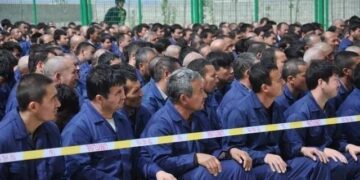
The government-in-exile detailed a range of abuses against Uyghurs and other Turkic peoples, including mass detention, forced sterilization, separation of children from their families, forced labor, and organ harvesting. These actions have been recognized by the United States as genocide and by United Nations bodies as crimes against humanity.
The ETGE warned that continued silence from Central Asian governments could enable Beijing’s expanding influence while undermining the sovereignty and long-term security of the region.
Calls for Coordinated Action
Beyond the C5+1 Summit, the government-in-exile called on Washington to encourage Kazakhstan, Uzbekistan, and Kyrgyzstan to raise the East Turkistan issue within the Organization of Turkic States and the Organization of Islamic Cooperation. The ETGE urged these bodies to formally condemn China’s actions and support international accountability mechanisms.
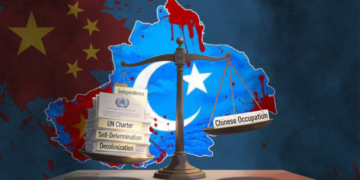
The government-in-exile also stressed that recognizing East Turkistan’s occupied status and supporting its independence would have strategic implications beyond human rights, affecting Eurasian balance of power, energy diversification, and regional stability.
Independence as a Strategic Imperative
In the statement, Mamtimin Ala, president of the East Turkistan Government-in-Exile, said U.S. policy toward Central Asia must explicitly address East Turkistan’s political status.
“Washington must make supporting East Turkistan’s independence a central component of its Central Asia strategy. A free and independent East Turkistan would contain Chinese expansion and restore the natural balance in the region.”
— Mamtimin Ala, President of the East Turkistan Government-in-Exile
As the United States signals continued engagement with Central Asia through future C5+1 meetings, exile leaders say the inclusion of East Turkistan in diplomatic discussions remains essential to any credible regional strategy.


