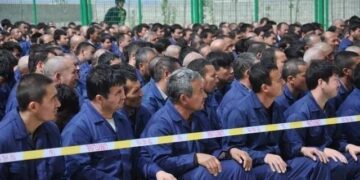
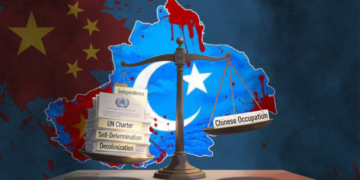
United Nations human rights experts have warned that state-imposed forced labour targeting Uyghurs, Kazakhs, Kyrgyz, and other native peoples across East Turkistan, which Beijing calls “Xinjiang (New Territory),” may amount to forcible transfer and enslavement as crimes against humanity.
In a statement issued on January 22, independent experts appointed by the United Nations Human Rights Council said they had identified a “persistent pattern” of coercive labour practices imposed through state planning, surveillance, and the threat of punishment. The experts said the practices extend beyond East Turkistan into multiple provinces and are embedded in government policy.
“In many cases, the coercive elements are so severe that they may amount to forcible transfer and/or enslavement as a crime against humanity.” — UN Special Procedures experts, statement, January 22, 2026
State-mandated labour transfers and surveillance
According to the experts, forced labour is enabled through the state-mandated “poverty alleviation through labour transfer” programme, which coerces Uyghurs and members of other native communities into assigned jobs in East Turkistan and across other parts of China. Workers are reportedly subjected to systematic monitoring, surveillance and exploitation, with no meaningful ability to refuse or change their work due to a pervasive fear of punishment and arbitrary detention.
Official Chinese planning documents cited by the experts show that a five-year plan in East Turkistan projected 13.75 million labour transfers between 2021 and 2025, with the experts warning that actual figures have reached new heights beyond those projections.
The experts said similar coercive schemes have been imposed on Tibetans through programmes that include military-style training and large-scale relocations. UN estimates indicate that hundreds of thousands were subjected to labour transfers in 2024 alone, alongside longer-term policies that have displaced communities from traditional agriculture-based and nomadic livelihoods.
The statement warned that labour and land transfers forcibly restructure communities, erode language and religious practice, and cause irreversible cultural harm under the guise of economic development.
Calls for accountability and supply chain scrutiny
Representatives of the East Turkistan Government in Exile said the UN warning underscores the consequences of continued international inaction.
“This is not a labour policy or an economic program. It is the systematic enslavement of a people carried out through state planning and enforced by fear.” — Salih Hudayar, Minister of Foreign Affairs, East Turkistan Government in Exile
📰UN Experts Warn of Systematic Enslavement as China’s Genocide in East Turkistan Enters Its 12th Year
PRESS RELEASE – For Immediate Release
WASHINGTON — On January 22, 2026, @UN independent experts issued a grave warning that the Chinese government is operating a state-imposed… pic.twitter.com/x48lauKvvr
— East Turkistan Government in Exile (ETGE) (@ETExileGov) January 22, 2026
UN experts also expressed concern that goods produced through forced labour are entering global supply chains, sometimes indirectly through third countries. They urged businesses and investors sourcing from China to conduct rigorous human rights due diligence in line with international standards and reiterated calls for unfettered access for independent UN human rights mechanisms.
“There is no path to ending genocide or enslavement while our people remain under Chinese colonial rule.” — Dr. Mamtimin Ala, President, East Turkistan Government in Exile
The experts said they have previously raised these concerns with Chinese authorities. Independent access to East Turkistan remains heavily restricted, limiting accountability as evidence of forced labour systems continues to accumulate.