





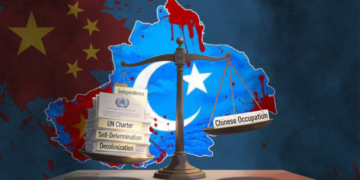


A U.S. War Department assessment released December 24 states that China’s military is explicitly tasked with suppressing East Turkistan independence, confirming that Beijing treats movements for self-determination as military threats rather than political questions.
The Annual Report to Congress on Military and Security Developments Involving the People’s Republic of China, issued by the United States Department of War, describes China’s “historic” military buildup and warns that it has made the United States “increasingly vulnerable.” The report also details how the Chinese Communist Party (CCP) directs the People’s Liberation Army (PLA) and internal security forces to counter what it defines as “separatism” in East Turkistan, Tibet, Hong Kong, and Taiwan.
Independence Treated as Military Threat
According to the report, the CCP is “highly sensitive to any perceived threat to its rule” and routinely frames political dissent as foreign-backed subversion. In this framework, independence movements are labeled “separatist” and cast as unacceptable threats to Party legitimacy.
The assessment states that the PLA is tasked with missions that include “oppos[ing] and contain[ing] Taiwan independence” and “crack[ing] down on proponents of separatist movements such as Tibet independence and the creation of East Turkistan.” These objectives are embedded in broader directives to safeguard political security, social stability, and what Beijing defines as national sovereignty.
Western Theater Command and East Turkistan
The report identifies China’s Western Theater Command as the country’s largest geographic command, responsible for border tensions with India and Central Asia as well as suppressing what Beijing calls the “three evil forces” of “terrorism, separatism, and extremism” in East Turkistan and Tibet.
Forces under the Western Theater include two group armies, military districts in East Turkistan and Tibet, and bases operated by the People’s Liberation Army Air Force and Rocket Force. The People’s Armed Police (PAP), the report notes, “plays a leading role securing China’s western regions.”
In July 2024, about 3,000 Chinese PAP, PLA, and public security personnel took part in a joint exercise in East Turkistan using helicopters, armored vehicles, and unmanned aerial systems to simulate “counterterrorism” operations—language critics say obscures repression of political identity and independence advocacy.
Exile Response and Policy Implications
Reacting to the assessment, Salih Hudayar, minister of foreign affairs and security of the East Turkistan Government in Exile, said the report confirms that China views East Turkistan and Tibet’s independence movements as military targets.
“The report confirms Beijing directs its military and security forces to violently ‘crack down’ on advocates of East Turkistan and Tibet independence, treating their rightful struggle for self-determination as a military threat.”
— Salih Hudayar, Minister of foreign affairs and security of the ETGE
Hudayar criticized the assessment for omitting the Xinjiang Production and Construction Corps (XPCC), a Chinese paramilitary-economic conglomerate with more than three million members that plays a central role in colonial governance and repression in East Turkistan. He said the report also fails to explicitly identify the PLA, PAP, and XPCC as instruments of genocide and systematic colonization.
Hudayar further urged U.S. officials to recognize East Turkistan’s right to self-determination, reject China’s “counterterrorism” narrative, and formally identify the PLA, PAP, and XPCC as instruments of colonial domination and genocide.


