







East Turkistan, what Beijing calls “Xinjiang (New Territory),” was the focus of renewed international calls for accountability on Thursday as the East Turkistan Government in Exile and the East Turkistan National Movement marked Uyghur Genocide Recognition and Remembrance Day, coinciding with the fifth anniversary of the United States’ formal determination that the People’s Republic of China is committing genocide and crimes against humanity against Uyghurs, Kazakhs, Kyrgyz, and other Turkic peoples. Leaders said recognition without enforcement has failed to halt an ongoing genocide rooted in occupation and colonial domination, with consequences extending beyond East Turkistan to the credibility of international law.
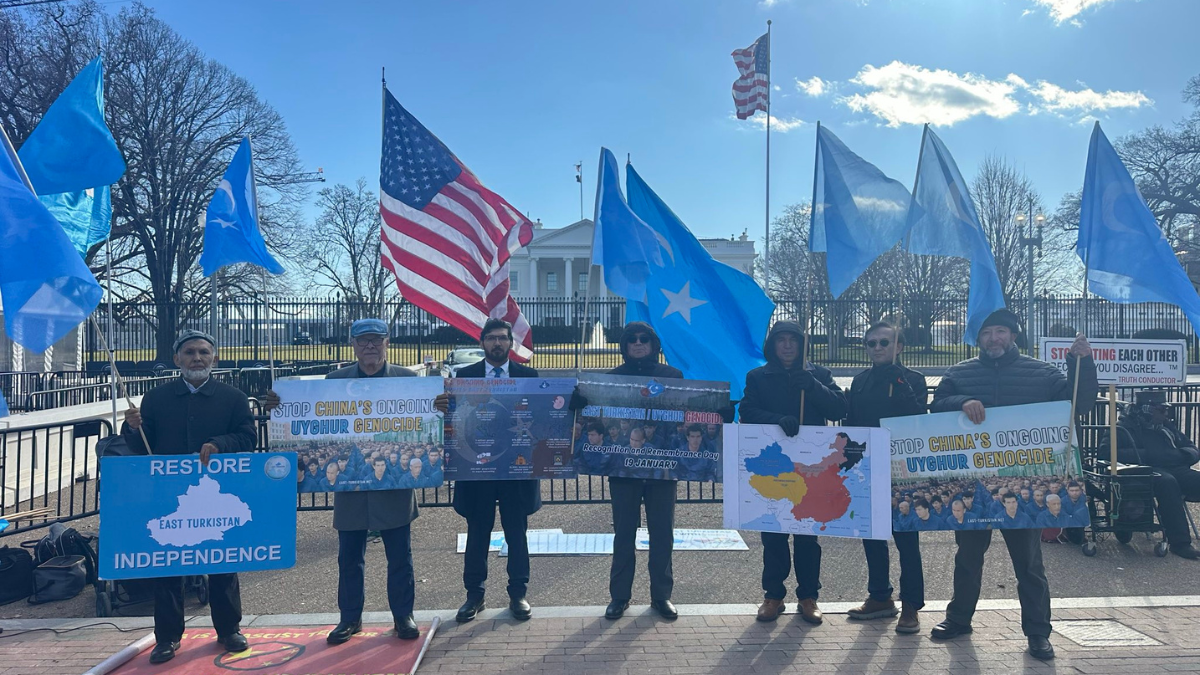
The anniversary was marked by coordinated statements and a vigil in front of the White House, where Uyghurs gathered to highlight the gap between formal acknowledgments and concrete action. Participants said the commemoration was intended to remind governments that have recognized the genocide to pursue accountability mechanisms capable of addressing genocide and crimes against humanity.
Genocide described as ongoing under occupation
The East Turkistan Government in Exile said Chinese colonization and military occupation of the territory began in 1949 and that the current phase of genocide was formally launched in 2014, when Beijing initiated what it called the “People’s War Against Terrorism,” later institutionalized as the “Strike Hard Campaign Against Violent Terrorism.” According to statements released for the anniversary, international scrutiny has led to shifts in tactics, but not in objectives.
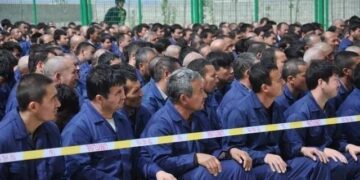
The exiled government and the East Turkistan National Movement said mass detention has been reorganized into prisons and judicial mass sentencing, while forced labour, coercive population-control measures, family separation, cultural and religious destruction, demographic engineering, and pervasive surveillance continue across East Turkistan. They said these policies target Uyghurs, Kazakhs, Kyrgyz, and other Turkic peoples as the native peoples of the occupied territory, rather than constituting isolated or incidental abuses.
The groups cited authoritative international findings, including the August 2022 assessment by the United Nations Office of the High Commissioner for Human Rights, which concluded that China’s actions may amount to crimes against humanity. Despite that assessment, they said, no United Nations investigative mechanism or accountability process has been established.
“There is no sustainable path to protecting the freedoms, human rights, or survival of our people without decolonization and the restoration of East Turkistan’s independence.”
— Dr. Mamtimin Ala, President, East Turkistan Government in Exile
Movement and exile leaders press for enforcement
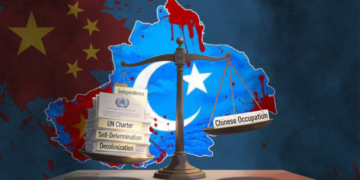
East Turkistan exile leaders said the fifth anniversary of the US determination highlighted the limits of recognition in the absence of enforcement. Movement leaders argued that treating the situation primarily as a human rights issue has allowed governments to avoid confronting what they described as its root cause: continued occupation and colonial domination.
“The genocide continues because it has been treated as a human rights issue rather than a crime rooted in occupation and colonization.”
— Salih Hudayar, Minister of Foreign Affairs and Security, East Turkistan Government in Exile; Leader, East Turkistan National Movement
At the White House vigil, participants also marked the anniversary of the determination announced by the United States Department of State, reiterating that conditions for the native peoples of East Turkistan have not materially changed despite formal recognition by Washington and several other governments. Hudayar called on the United Nations and its member states to move beyond documentation and statements of concern.
The East Turkistan Government in Exile and the East Turkistan National Movement urged states to support international accountability mechanisms, including investigations by the International Criminal Court and proceedings at the International Court of Justice, and to address the national question of East Turkistan under international law.
They said East Turkistan / Uyghur Genocide Recognition and Remembrance Day must serve not only as a moment of remembrance, but as a demand for justice and decisive international action, warning that without accountability and decolonization, the genocide will continue despite global acknowledgment.


