






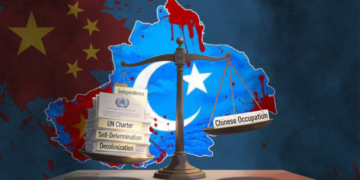


The 2025 Annual Report of the Congressional-Executive Commission on China (CECC) concludes that China’s genocide against Uyghurs and other Turkic peoples in East Turkistan is ongoing, systematic, and directly relevant to U.S. policy. Rather than documenting a winding down of repression, the CECC report finds that Chinese state authorities have reorganized the architecture of mass atrocity, shifting from highly visible internment camps to prisons, forced-labor systems, coercive population controls, and entrenched surveillance.
The Commission treats East Turkistan not as a closed chapter or historical case study, but as an active test of Washington’s commitments under genocide prevention, trade law, and international human-rights obligations.
An atrocity system, not a closed chapter
The CECC rejects narratives suggesting that the disappearance of large-scale “re-education camps” signals improvement. Instead, it emphasizes continuity of purpose beneath changing tactics.
“The disappearance of camps does not indicate de-escalation; it reflects institutional adaptation.”
The report documents how policies that underpinned earlier genocide and crimes-against-humanity findings remain in place, even as their outward form has shifted under international scrutiny.
A congressional genocide ledger, not a generic rights memo
As a bipartisan body created by the U.S. Congress, the CECC’s annual reports function as an official legislative record shaping sanctions, trade enforcement, and executive-branch action. In 2025, East Turkistan anchors the Commission’s broader analysis of genocide, forced labor, and transnational repression across China.
The CECC explicitly aligns its assessment with the U.S. Holocaust Memorial Museum Simon-Skjodt Center, which continues to find that the Chinese state is committing mass-atrocity crimes against Uyghurs and other Turkic peoples.
Rather than presenting the situation as a clash of competing narratives, the Commission grounds its conclusions in conduct corresponding directly to Article II of the Genocide Convention, including serious bodily and mental harm, destructive conditions of life, coercive birth-prevention measures, and the forcible transfer of children.
“The legal basis for genocide findings remains intact, even as methods are reconfigured.”
From camps to prisons: reconfiguration, not retreat
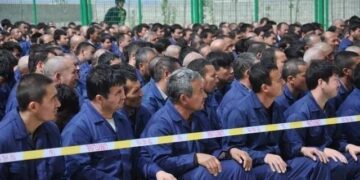
One of the report’s most consequential analytical findings is its treatment of incarceration. The CECC documents the transfer of large numbers of Uyghurs and other Turkic peoples from extrajudicial internment facilities into formal prisons and Public Security Bureau detention centers, often under broadly defined “terrorism,” “separatism,” or “extremism” charges.
Credible reporting cited by the Commission indicates that more than half a million people remain incarcerated, with torture, sexual violence, and deaths in custody continuing to be documented. The shift, the CECC argues, reflects an effort to normalize repression within judicial and administrative systems rather than dismantle it.
Forced labor and the globalization of complicity
Forced labor occupies a central place in the 2025 report, treated both as a tool of repression and as the primary channel through which international markets become entangled in Beijing’s crimes. The CECC traces how Uyghurs and other Turkic peoples are funneled through state-run “labor transfer” programs into factories and farms inside and outside East Turkistan under coercive conditions.
A key focus is the Xinjiang Production and Construction Corps (XPCC), already sanctioned by the U.S. Treasury. The Commission calls for a formal sanctions evaluation, linking XPCC to cotton, tomatoes, peppers, and components used in solar and other strategic industries entering global supply chains.
The report also ties forced labor to land seizures and so-called “poverty alleviation” programs that dispossess Uyghur farmers, reframing these policies as instruments of economic colonization rather than development.
Birth prevention, child separation, and demographic destruction
The CECC devotes extensive attention to coercive population-control policies targeting Uyghurs and other Turkic peoples, including forced sterilizations, IUD insertions, abortions, and punitive enforcement of birth quotas.
The Commission explicitly situates these practices under Article II(d) of the Genocide Convention, which prohibits measures intended to prevent births within a protected group. It also documents the expansion of state boarding schools and child-separation systems that sever children from family, language, and religion, corresponding to Article II(e).
“Together, these policies aim not only to suppress a people, but to pre-empt its future.”
Transnational repression beyond East Turkistan
The CECC underscores that China’s campaign extends far beyond the borders of the occupied country. The report documents deportations of Uyghurs from third countries such as Thailand and Cambodia, followed by imprisonment, torture, or death in custody.
It also details intimidation of diaspora communities through digital harassment, threats to relatives, and exit bans, warning that these practices suppress advocacy and distort international accountability. The Commission urges U.S. agencies to treat transnational repression as a national-security issue rather than a peripheral human-rights concern.
What the CECC expects Washington to do
The report pairs documentation with a concrete policy agenda, calling for:
- A UN Security Council or Arria-formula briefing on mass-atrocity risks in East Turkistan and Tibet
- A Treasury sanctions evaluation of XPCC and related entities
- Stronger enforcement and expansion of the Uyghur Forced Labor Prevention Act Entity List
- Increased funding for uncensored broadcasting in Uyghur and other at-risk languages
- An “Endangered Voices of East Asia Fund” to support threatened cultures and languages
At the executive level, the Commission urges integration of East Turkistan into country strategies, sanctions regimes, visa policies, and democracy-assistance programs, backed by regular congressional reporting.
Why this matters for East Turkistan
Taken together, the 2025 CECC report constructs a coherent picture of a long-term project to dismantle the people of East Turkistan as a nation and absorb their land, labor, and future into a Chinese-dominated state and global economy. By tying conditions on the ground to genocide law and concrete policy tools, it offers governments a framework to treat the colonization and ongoing genocide as central, not peripheral, to their China policy.
For East Turkistanis in exile, the report marks a shift from moral appeal to institutional leverage. For other states, it poses a stark question: whether East Turkistan will continue to be treated as an “internal affairs” issue, or as what the evidence shows it to be, an ongoing genocide demanding response.


